FilmEU is more than a project.
It is unlike any other undertaking in arts and culture education, bringing together eight European Higher Education Institutions.
Together, these institutions collaborate around the common objective of jointly promoting high-level education, innovation and research activities in the multidisciplinary field of Film and Media Arts and, through this collaboration, consolidate the central role of Europe as a world leader in the creative fields.
FilmEU is the most positive and transformative whole of higher education initiative yet conceived for the sector in Europe.
With the European Universities programme, the EU is building bridges between institutions and countries.
FilmEU brings together eight European Higher Education Institutions:
- Institute of Art Design and Technology Dún Laoghaire Dublin / Ireland
- ULHT Lusófona University Lisbon / Portugal
- Baltic Film and Media Arts School / Tallinn
- LUCA School of Arts Brussels / Belgium
- VŠMU Academy of Performing Arts / Slovakia
- LMTA Lithuanian Academy of Music and Theatre / Lithuania
- VIA University College / Denmark
- NATFA National Academy for Theatre and Film Arts “Krustyo Sarafov” / Bulgaria.

FilmEU launches landmark position paper on the impact of AI on future jobs in film and media
FilmEU is proud to announce the launch of its first-ever position paper, developed through its pioneering AGORA think tank initiative.
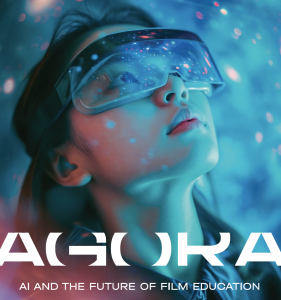
Led by the dedicated Work Package 5 – PEOPLE, AGORA brought together a dynamic group of eight academics and sixteen students from across the FilmEU consortium.
Over several months, the group engaged in intensive discussions, workshops, and exchanges with guest speakers from both the AI and film and AV industry and academia, sharing knowledge and best practices.
The result is a groundbreaking position paper exploring the impact of AI on future jobs in film and media.
This document reflects the collective expertise, creativity, and forward-thinking vision of the Alliance, and serves as both an educational resource and a thought-provoking contribution to wider debates on the future of work in the creative industries.
By addressing one of the most urgent challenges facing film and media education and practice, this position paper will not only inspire the FilmEU community but also resonate with educators, practitioners, and policymakers well beyond the Alliance.
Read the full position paper here: https://www.filmeu.eu/files/revista%20agora_filmeu_25.pdf

Report Launch: Mapping Ireland’s Factual and Documentary Screen Sectors
Documentary and factual programming are central to Irish screens — from acclaimed feature docs on the festival circuit to the steady presence of non-fiction on television. Yet, compared with drama, fiction and animation, the sector is often less visible and less celebrated.
On September 12, 2025, as part of the IFI Documentary Festival, IADT launched an extensive new report at the Irish Film Institute to shed light on this vital part of the screen industry.
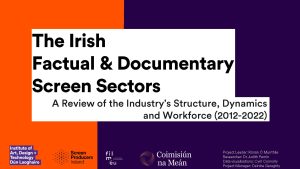
Funded by Coimisiún na Meán (formerly the BAI), the study was authored by IADT’s Rónán Ó Muirthile and Dr Judith Pernin.
The 90-page publication, “The Irish Factual & Documentary Screen Sectors: A Review of the Industry’s Structure, Dynamics and Workforce (2012–2022)” offers a detailed analysis of production, funding, distribution and exhibition, alongside insights into workforce experiences drawn from a survey and interviews with directors, producers, festival programmers, funding bodies, and crew members.
Findings highlight both systemic challenges such as precarious work, low pay and under-representation, as well as examples of good practice and positive change.
The launch event drew an audience of around 60 industry and cultural stakeholders, including representatives from the Arts Council, Screen Producers Ireland, RTÉ and Coimisiún na Meán.
A panel discussion featuring Steve Carson (RTÉ), Roisin Geraghty (Producer) and Ross Whitaker (Director/Producer) sparked lively debate about the sector’s future.
Supported by Screen Producers Ireland and conducted in parallel with the Horizon Europe project Crescine, the IADT-led research creates opportunities for stronger collaboration between academia and industry, both in Ireland and across Europe.
By mapping the structure, dynamics and workforce of Ireland’s factual and documentary screen sectors, the report provides an invaluable evidence base for policymakers, practitioners and cultural institutions, and raises the profile of a field too often overshadowed by fiction and drama.
FilmEU Leadership Statement
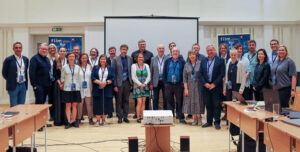
FilmEU, the European University for Film and Media Arts represented by the Academic Council, comprising Rectors, Presidents, Deans, steering committee, student and staff representatives convened in Bratislava, Slovakia last year and unanimously agreed to issue the following statement:
“Following on from our European Degree Label Policy Experimentation project, ETIKETA, FilmEU – European University of Film and Media Arts welcome the Commission’s focus on cross-border cooperation and continued efforts to remove regulatory obstacles to better integrate and align national policies across our member states in support of a future European degree classification.
We recognise, and are committed to working closely with our national quality agencies, to advance the ongoing transformational process the European Universities initiative entails.
The European Education Area – and our alliance – ultimately supports increased mobility and includes a vision for better teaching and learning along with stronger research and innovation.
We also welcome the collaborative efforts that led to the publication of the European Education package.
We particularly look forward to further developing our ideas and proposals on the pathway to a European degree framework that we are convinced will greatly benefit our individual Institutions and other Alliances of national peer institutions in their internationalisation efforts.”

FilmEU Summit 2025 in Sofia, Bulgaria
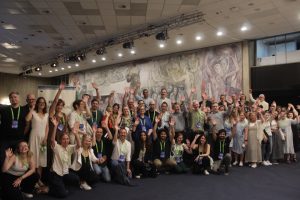
The FilmEU Summit 2025 took place in Sofia at NATFA (National Academy for Theatre and Film Arts) from June 3–6, bringing together students, educators, researchers, and industry professionals from across the FilmEU alliance and associated partners.
Under this year’s theme “CommUnity”, the summit featured a series of interactive intercultural workshops, including the Future Campus workshop, designed to envision collaborative educational spaces.
The AGORA forums offered open discussions, notably addressing the impact of artificial intelligence on jobs in film and media.
The inaugural FilmEU Film Festival, running each evening, showcased outstanding student films from across the alliance and related MA programmes.
Attendees were also welcome to visit the ARE artistic research exhibition which explored the themes of “Synthetic Rewilding: Between Nature and the Machine”.
Keynotes included Sandra Jovchelovitch on building educational communities, and Eduardo Souto de Moura on designing future learning environments.
Alongside formal sessions, the Summit offered enriching cultural and social events, highlighting Sofia’s artistic heritage and enabling ample networking and collaboration across Europe’s film and media education sectors.
FilmEU Projects
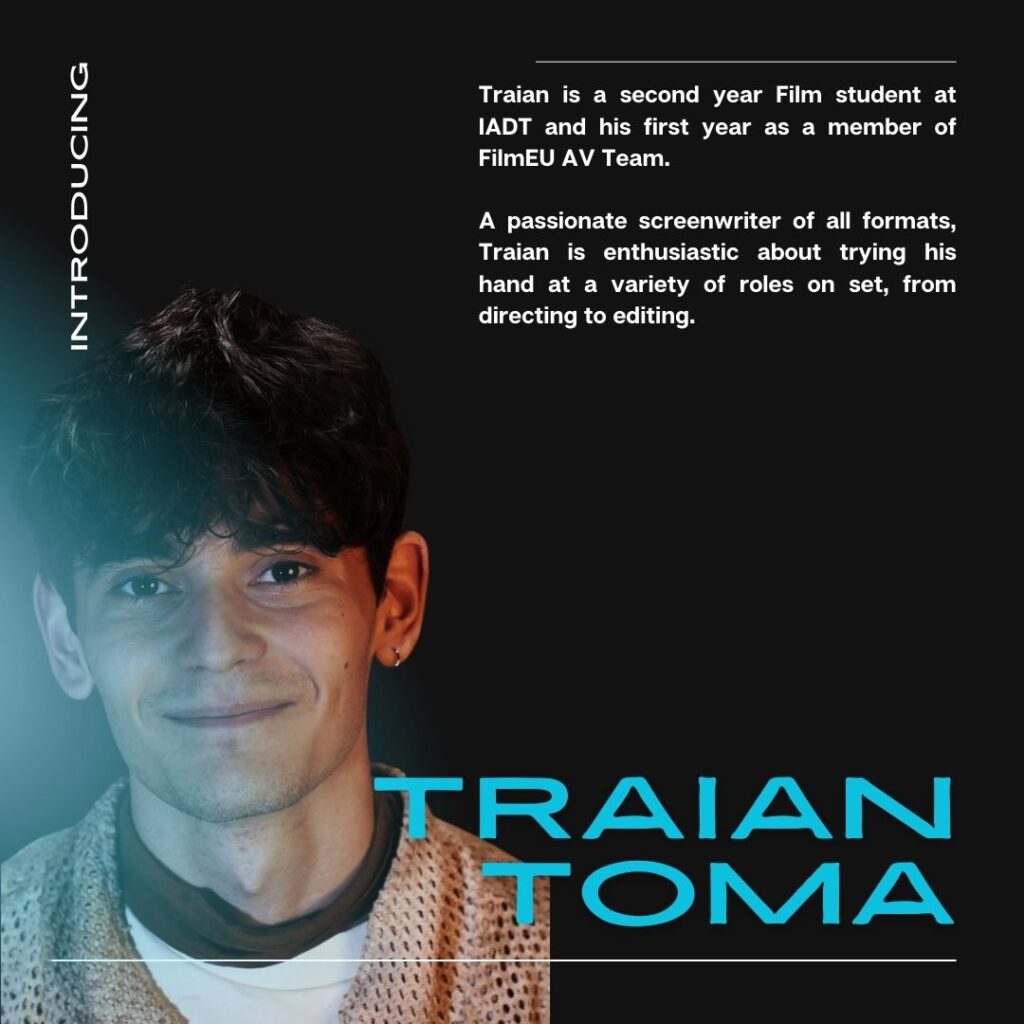
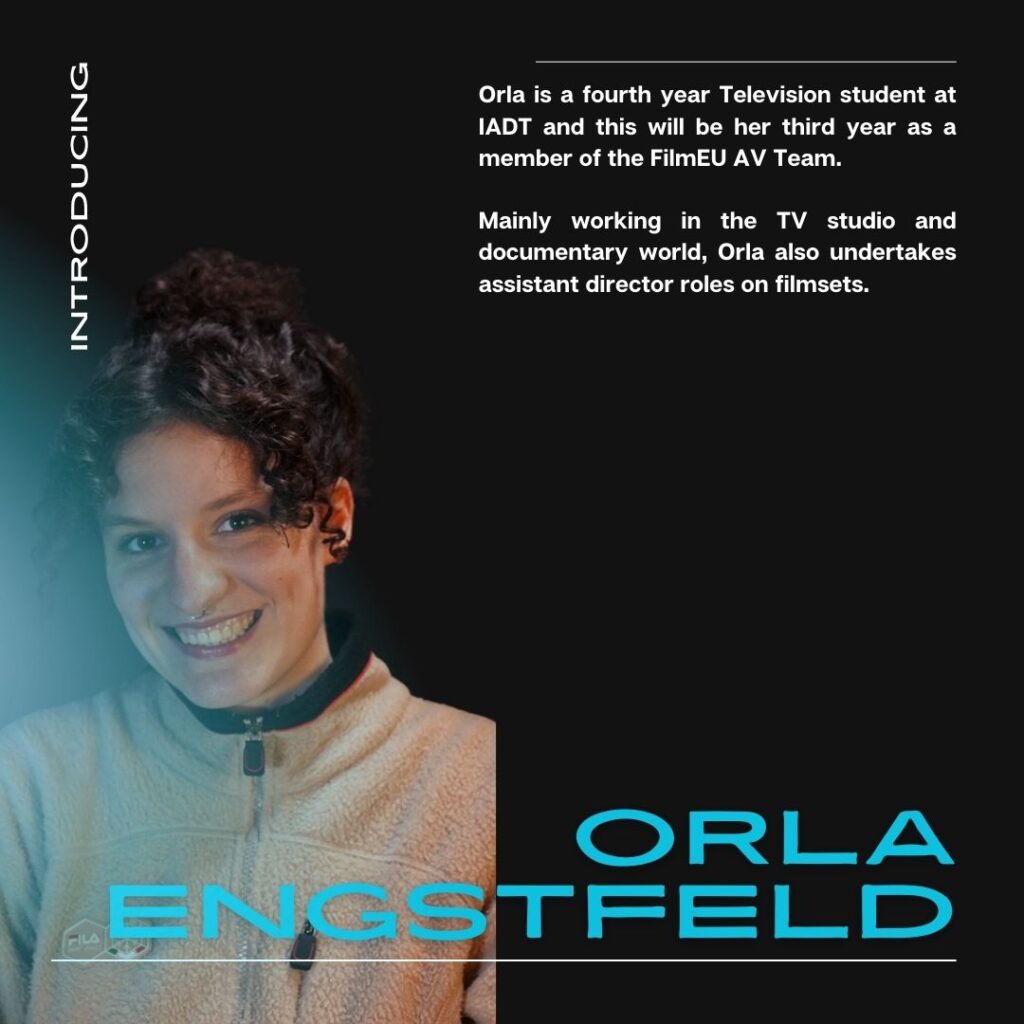
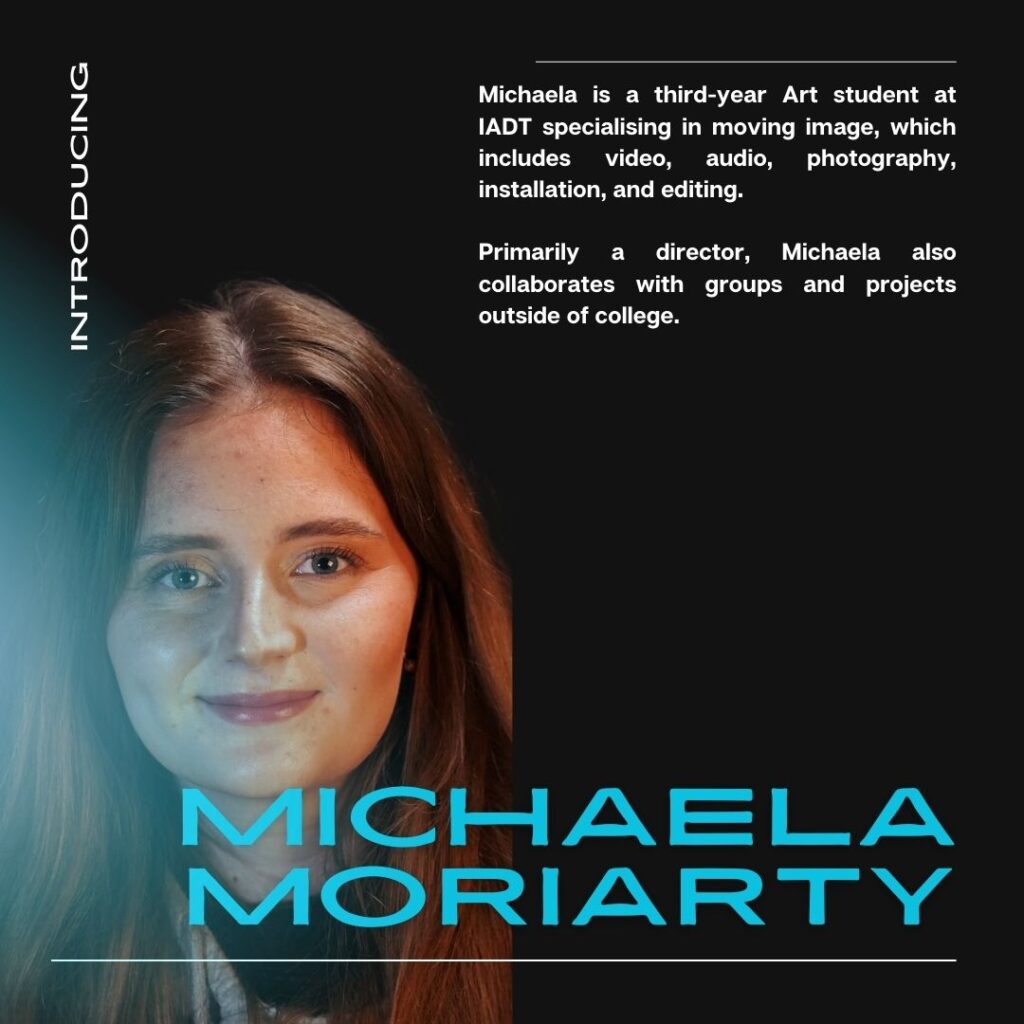
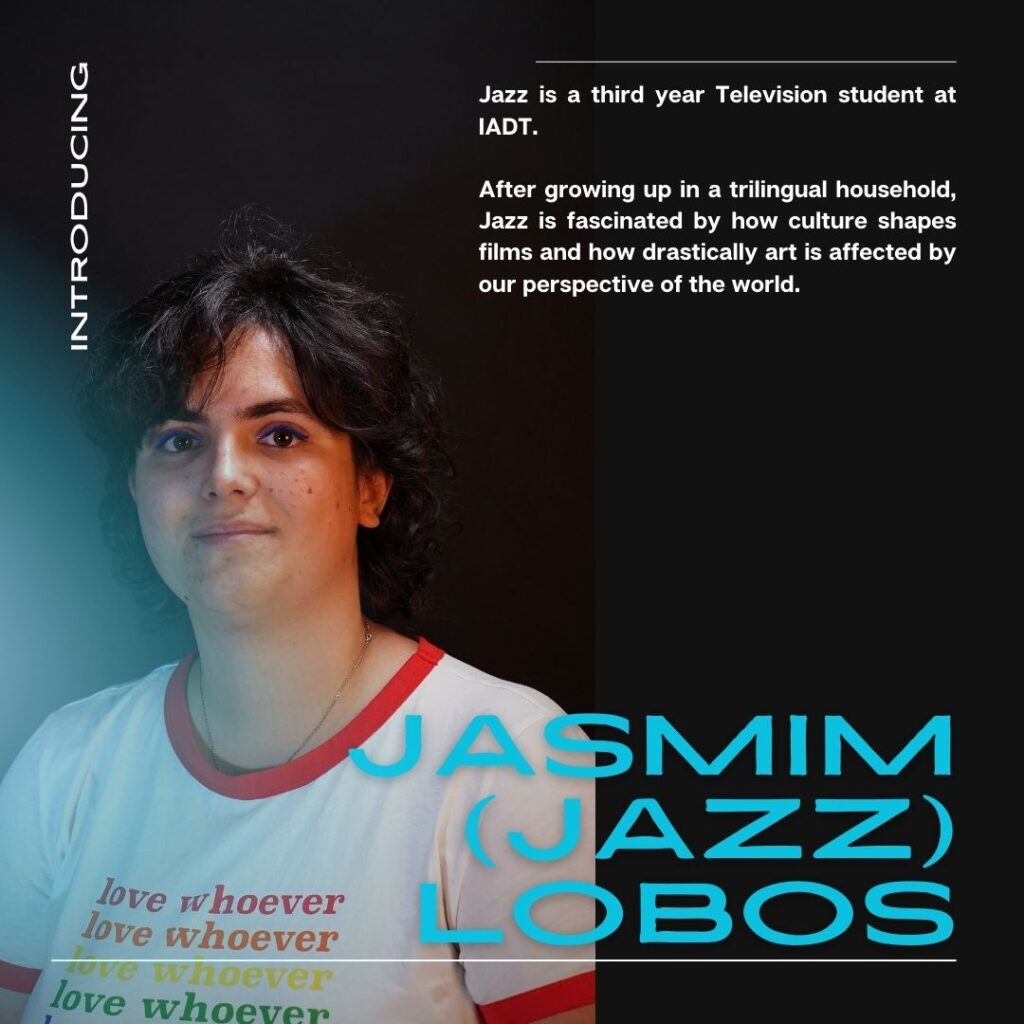
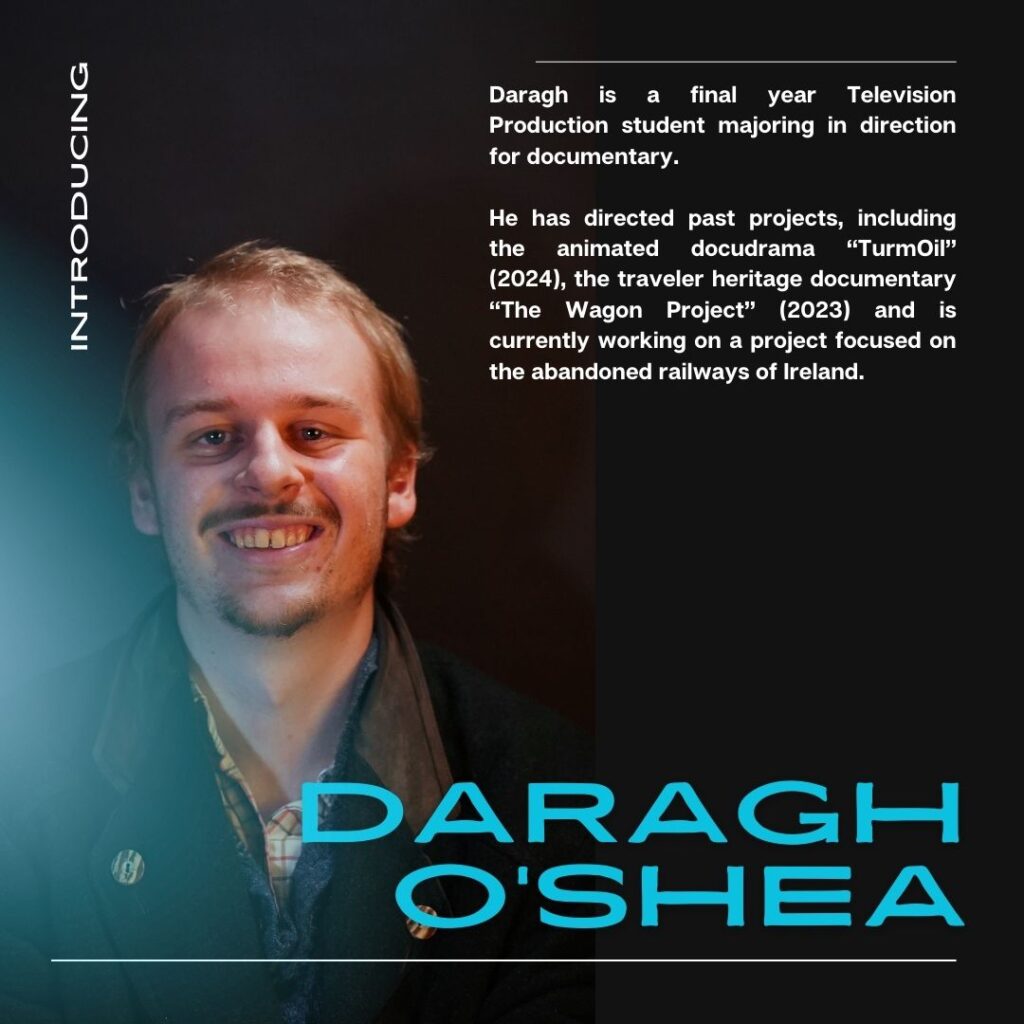
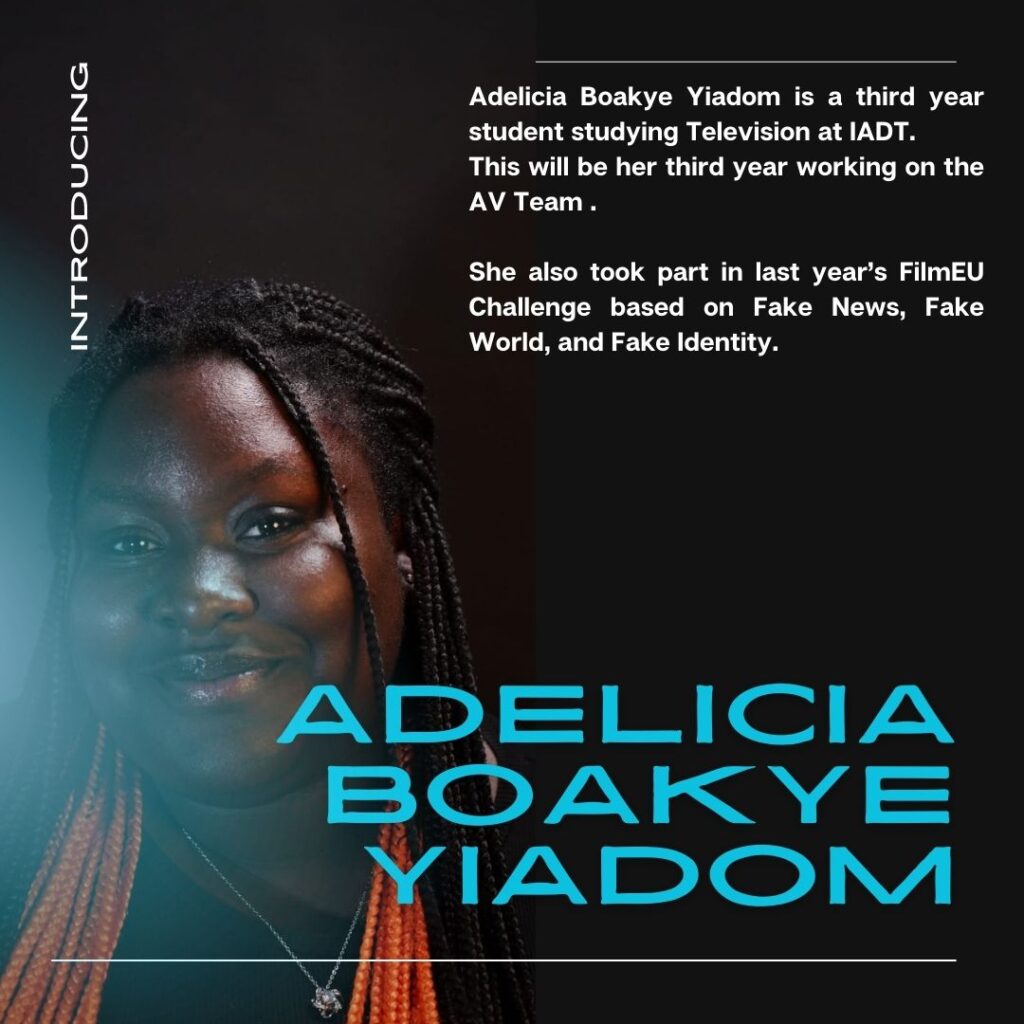
Welcoming this year's IADT FilmEU AV Team
IADT’s Barry Dignam Elected as GEECT Regional Chair at CILECT 2024 Congress
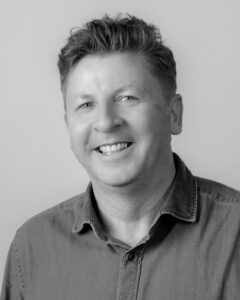
October 2024 | Beijing, China – The Institute of Art, Design & Technology’s (IADT) Barry Dignam has been elected as the new GEECT Regional Chair and to the Executive Council of CILECT, the world’s largest association of film and television schools.
A celebrated filmmaker and educator with a career spanning over two decades, Dignam is known for his leadership within the European film education landscape as well as in FilmEU, a European university alliance dedicated to advancing creative education.
Attending the 2024 CILECT Congress at the Communication University of China (CUC) in Beijing, Dignam and Jean Rice led the Irish and IADT delegation.
“This is a great opportunity to continue the work of connecting European film schools and navigating the challenges and opportunities of technological change, increasing diversity and sustainability in our industry,” he said.
“I look forward to collaborating with colleagues to ensure the growth and inclusivity of our global community.”
Dignam received 40 votes compared his opponent Jyoti Mistry from the Valand Academy (HDK), Sweden who received 28 votes.
His election as the new Regional Chair of GEECT, the European chapter of CILECT, also positions IADT and Ireland at the forefront of film and media education in Europe.
This year’s CILECT congress, themed “Artificial Intelligence and Film Education,” brought together over 100 film schools from more than 50 countries to discuss the role of AI in shaping the future of creative education.
Dignam and Rice also actively engaged in discussions exploring AI’s potential impact on media education methodologies, curriculum development, and cross-disciplinary collaborations.
Keynote speakers, including Creative Technologist and Cinematographer Saloni Shukla, emphasized the importance of balancing technological advancements with the cultivation of core human skills like critical thinking and creativity.
As a proud member of international alliances such as FilmEU, ELIA, and CILECT, IADT values the strength of global networks in enhancing the quality and reach of its educational programmes.
These partnerships not only support knowledge exchange and research but also create diverse opportunities for students and staff to collaborate across borders.
Manuel José Damásio, FilmEU Coordinator as well as Head of the Film and Media at Lusofona University was also elected to president of CILECT having previously served as Regional Chair of GEECT between 2020 and 2024.
FilmEU Talks - Experts on Air: AI in Fashion and Fashion Film, October 23 2024
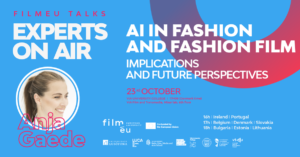
For the past four years, FilmEU – European University has been hosting numerous FilmEU Talks – Experts on Air events, bringing together specialists and professionals from various creative industries.
These events have offered invaluable insights to FilmEU students, educators and researchers, showcasing the breadth of expertise in the field.
As we enter the new academic year, we are excited to announce a series of engaging sessions, accessible both in person at one of the FilmEU partner institutions or online for participants in other countries.
The first talk of the year, featuring Anja Gaede, will explore the role of AI in the fashion and film industries.
Attendees will gain insights into how AI relates to these industries from both commercial and educational perspectives, with concrete examples of value creation as well as discussions on ethical considerations.
Date: 23rd October
Time: 16h00
Location: Film and Transmedia, Mixer lab, 6th floor, Via University College
Online: Zoom https://lnkd.in/dpDJbFTQ
Don’t miss this opportunity to engage with cutting-edge ideas in the world of AI, fashion, and film!
Read more about the FilmEU European University: www.filmeu.eu
FilmEU Summit in Bratislava, Jun 3 - 6
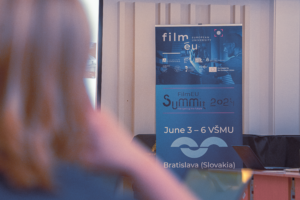
The 4th FilmEU Summit was held from June 3rd to 6th at VŠMU University in Bratislava, Slovakia, marking a significant milestone as the first summit with all eight partners present: Universidade Lusófona – Centro Universitário Lisboa, Dún Laoghaire Institute of Art, Design and Technology, LUCA School of Arts, Tallinn University, VŠMU University, VIA University College, LMTA, and the National Academy of Theatre and Film Arts “Kr. Sarafov”.
The summit began with an insightful Leadership Symposium focusing on the legal status of European Universities and the European Education Package.
Leaders and vice-deans gathered to discuss the future landscape of European higher education. The afternoon featured productive work package meetings, culminating in the General Assembly of the FilmEU Association aligning our mission and strategies.
The second day officially kicked off with the public segment of the FilmEU Summit. The academic council and steering committee convened in the morning, followed by a keynote from Jakob Isak Nielsen of Aarhus University on “Future Models for the Film Industry in Small Countries.”
The discussions then delved into future R&I capacity and innovation within our European university and FilmEU partners, supported by our specialized toolkits. The day concluded with showcasing the results of the Samsara Challenge by this year’s FilmEU students.
The final day of the summit was a culmination of a week full of activities and discussions. Highlights included presentations from the Seminal Funding Project and a lecture on Cultural Intelligence. Additionally, the FilmEU Audiovisual team had a special moment at the end, screening their work to the students and sharing feedback on the collaboration activities and event coverage.
Watch the recap of each day below:
FilmEU Talks – Experts on Air / Kieran Lynch April 17th
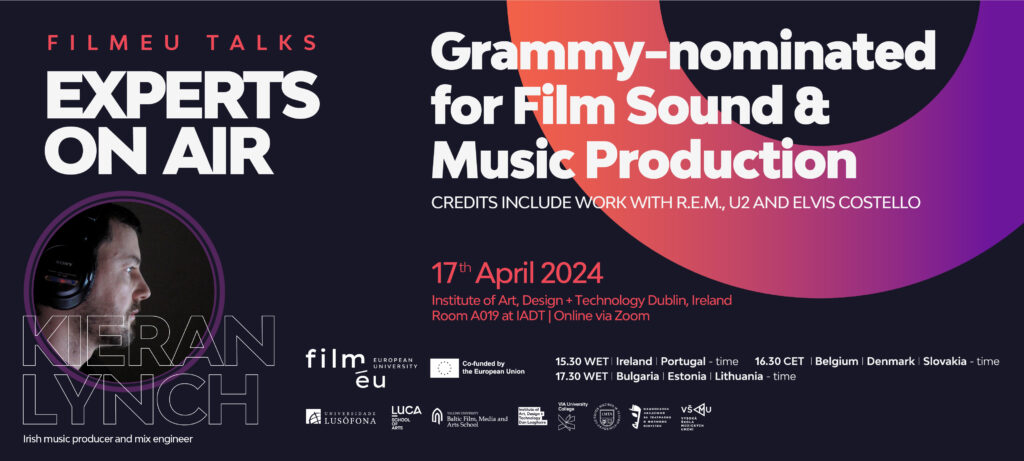
Kieran Lynch is a Grammy-nominated Irish music producer and mix engineer with over 25 years of experience working in the Music, TV and Film industries. Kieran’s list of credits includes projects with R.E.M., U2, Elvis Costello, The Beautiful South, and The Corrs. Kieran’s Film work comprises soundtracks for features such as ‘Get Rich or Die Tryin’, ‘In America’, ‘The Tailor of Panama’, ‘Frank’ and ‘Sing Street’. Kieran also works in film and television post-production sound and has been nominated for a prestigious Golden Reel award.
Kieran will be talking about his extensive experience in Sound and Music Production for Film, both the challenges and highs. In addition to this lengthy industry experience, since 2014 Kieran has worked as a lecturer in sound at Dundalk Institute of Technology, Dundalk, Ireland and in 2022 he joined us here at IADT Dun Laoghaire.
Kieran’s recent research focuses on accessibility through audio, particularly in the production of audio-described content. He is an active member of the EBU Timed Text group.
This is an event not to be missed by any music or film enthusiast!!
When: 17th April 2024
Time: 15:30 Western European Time, 16.30 Central European Time, 17.30 Eastern European Time
Where: IADT and online at Zoom
To Register click this link: https://videoconf-colibri.zoom.us/meeting/register/tJ0qfumsrDsiEtCA8a_pz5TWy0ug2ruDUTeI
IADT/FILMEU CINECLUB Screening 'Pilgrimage' Wednesday 13th March

Ready for an action-packed adventure into Medieval Ireland?
IADT are screening Pilgrimage (2017) directed by Brendan Muldowney and starring Tom Holland (Spiderman).
So what’s it about?
A novice monk must escort a sacred relic from Ireland to Rome at the Pope’s request. However, he and his brotherhood face a perilous, violent journey fraught with danger and find themselves questioning their faith in the Church and religious beliefs.
The screening (96’ minutes) will be followed by a Q&A session with Brendan the Director, who is a graduate of our very own National Film School. Here you will have an opportunity to ask him about his vivid recreation of Ireland in 1209 AD and any other burning questions about the trade that you may have.
Where;
Live on Campus in room A019 and via ZOOM for our European colleagues and friends.
When?
Wednesday 13.03.2024
- 16h00 Portugal/ Ireland time zone
- 17h00 Belgium/ Denmark/ Slovakia time zone
- 18h00 Estonia/ Lithuania/ Bulgaria time zone
Don’t miss this exciting opportunity and join this free Cineclub!
FilmEU Talks - Experts on Air/ Dirk Hoyer February 21st
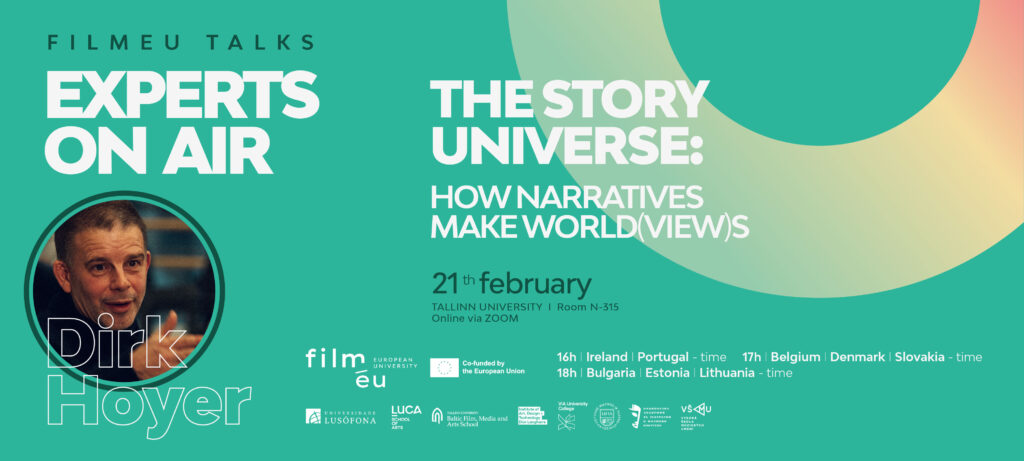
The next FilmEU Talks: Experts on Air will be hosted by Tallinn University on February 21st, featuring the Dirk Hoyer. Dirk is not only a screenwriter, researcher, and filmmaker but also an Associate Professor at BFM in Tallinn.
With several documentaries, award-winning screenplays, and academic articles under his belt, Dirk’s expertise revolves around storytelling, political imaginaries, and film history. His latest book, “Retopia – Creating New Spaces of Possibility,” was published by Routledge in 2023.
Don’t miss this fantastic opportunity! Join in the conversation online via Zoom. It’s a perfect chance for documentary enthusiasts to engage in a head-to-head discussion with a specialist.
Register here to receive the Zoom link:
Read more about the FilmEU European University:www.filmeu.eu
IADT/FILMEU Screening 'Deliveries' Wednesday 13th December
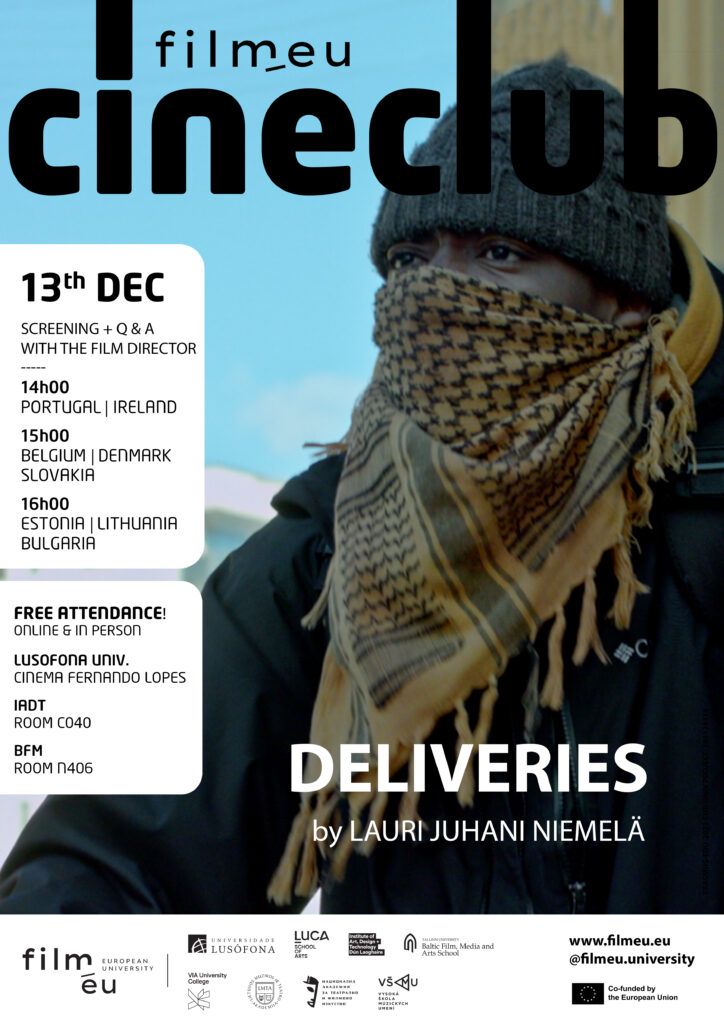
The Baltic film, media and arts school in Tallinn University/FilmEU invites you to our Cineclub on Wednesday, December 13th at 14:00 Irish time. The event takes place in Room C014 and online.
We are screening “Deliveries” (20min; 2020) by BFM alumni Lauri Juhani Niemelä. The film is Lauri’s graduation film and is a contemporary short fiction film about loss, dissociation and the act of coping in an unusual way.
The FilmEU Cineclub starts with a talk with the director Lauri Juhani Niemelä who graduated from the BFM Audiovisual Media MA programme in 2020 and is currently living in Finland.
🗓 13th December
🎓 IADT (Ireland)📍 Room C040⏰ 14h00
🔗 https://videoconf-colibri.zoom.us/meeting/register/tJMvduGoqD0pGtxZsfhACj-vKkRRVesBJBBz
📚 About the film: “Deliveries” (2020). Chia works as a food deliverer in Tallinn. One day he brings an order to a flat, where he finds the landlady is lying on the floor with no signs of life.
This film is not to be missed. We look forward to seeing you all.
FilmEU Talks - João Monteiro 6th December

We’re thrilled to have João Monteiro as our special guest for a Filmeu Talk on December 6th! With a degree in Art History from the FCSH of Universidade Nova de Lisboa, João Monteiro has been a driving force in the world of cinema and horror. He’s the founder of CTLX – Cineclube de Terror de Lisboa and the visionary behind MOTELX – Lisbon International Horror Film Festival.
In 2018, João directed the award-winning documentary “Nos Interstícios da Realidade ou o Cinema de António de Macedo.” His commitment to the world of horror and Portuguese cinema is truly commendable. Notably, in 2022, he, along with Filipa Rosário, co-edited the book “O Quarto Perdido do MOTELX – Os Filmes do Terror Português (1911-2006)” (The Lost Room of MOTELX – Portuguese Horror Films (1911-2006)).
The event will be live-streamed via Zoom, so you can join the conversation from anywhere via this link: https://videoconf-colibri.zoom.us/meeting/register/tJYpcu-pqzgtGdKY2Dq5_sGPU_vZlN61mioZ at 4pm Irish Time.
João Monteiro will share insights, experiences, and knowledge in the world of cinema and horror. It’s an opportunity you don’t want to miss!
Whether you’re a cinema enthusiast, aspiring filmmaker, or simply curious about the magic behind the screen, this FilmEU Talks is for you so please feel free to tune in.
FilmEU Summit in Genk, Oct 2nd-Oct 6th
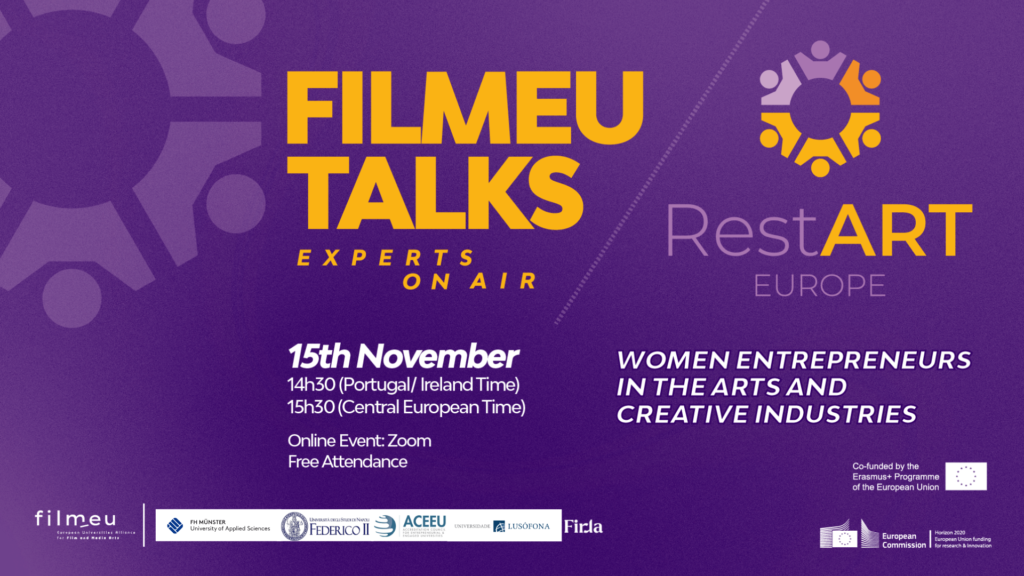
Join us for an exclusive live event where you will have the unique opportunity to get a first-hand look at the cutting-edge platform created. This event will provide a comprehensive overview of its features and functionalities.
Event Highlights:
- Platform Showcase: Dive deep into the platform’s user-friendly interface and explore its diverse capabilities designed to enhance the learning and creative experience.
- Insights from Experts: Hear from renowned experts, who will share their perspectives on the platform’s potential impact.
- Interactive Q&A: Get your questions answered directly by our team and the experts involved in this ground breaking initiative.
When: November 15th 2023
Time: 15:30 Central European Time
Location: https://videoconf-colibri.zoom.us/meeting/register/tJ0tcOChqDkqGN25zNE8JBg_Dm5_PpijNmKM
RestART and FILMEU are committed to pushing the boundaries of creativity, innovation, and education, and we can’t wait to share our journey with you.
FilmEU Summit in Genk, Oct 2nd-Oct 6th
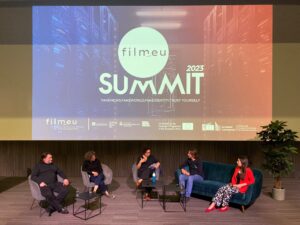
FilmEU+ Rectors Meeting
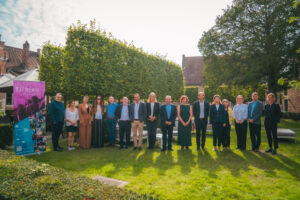
FilmEU Talks - Experts on Air/ Masterclass with awards winning Portuguese director, João Canijo

SAVE THE DATE! We invite you for the first FilmEU Talk this academic year. On Wednesday, September 27th , João Canijo, an award-winning Portuguese director, will give a masterclass on 27th September at 19h20 (Portugal time) where he’ll talk about his latest two films, Bad Living and Living Bad, with a special focus on Bad Living which won the Silver Bear at the Berlin Film Festival.
Free Attendance
📍Cinema Fernando Lopes (Lisbon, Portugal)
📍Online via Zoom
More information about the film: https://www.imdb.com/title/tt14007288/.
Read more:
https://www.filmeu.eu/news-and-events/filmeu-talks
Register at:
Follow FilmEU on social media:
Filmeu – European Universities Alliance for Film and Media Arts
Etiketa meeting in Barcelona
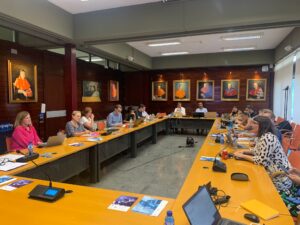
On September 12th, during a meeting in Barcelona, Etikéta team presented some first drafts for the visual identity of the Digital Label, marking a significant milestone in our journey.
We delved deep into critical discussions, including Policy Experimentation Alliances & QA Agencies Round Table, and Setting the Future with a Common Strategic Vision for Joint European Degrees.
Stay informed and engaged by visiting the Etiketa website for the latest updates and insights. Together, we’ve shaped the future of European education: etiketa.filmeu.eu
C-Accelerate partners met at Aalto University
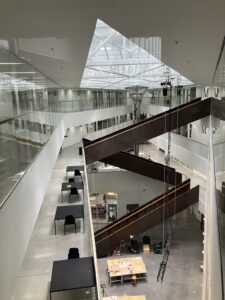
On August 30th, FilmEU – European Universities Alliance for Film and Media Arts staff visited leading partner Aalto University‘s campus and Design Factory. Together with 40 students from Dún Laoghaire Institute of Art, Design and Technology, BFM-Tallinn University, Universidade Lusófona – Centro Universitário Lisboa and Luca School of Arts. During the day they met the consortium of the other EIT Digital project: INCREDIT and finished with a collaborative brainstorming session with the students about start-up issues and how to trigger the entrepreneurial mindset in our educational institutions. The next two days were for workshops about Aalto’s technology transfer office, and education with an entrepreneurial mindset. Parallel the students worked on the research question: ‘How to make the universities of the future more entrepreneurial?’.
Etiketa Project
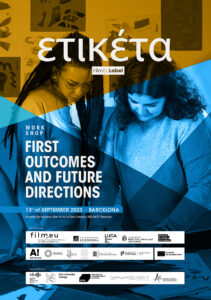
September 13th, team of Etiketa, a project that IADT is a partner of, will present the first draft of the Digital Label.
Policy Experimentation Alliances & QA Agencies Round Table and Setting the Future – A Common strategic view for Joint European Degrees are some of the topics that will be discussed.
14h45– Opening Session
Manuel José Damásio – ETIKETA & FilmEU Coordinator (Lusófona University)
Marc Van De Walle – WP 4 leader and ETIKETA & FilmEU Partner (LUCA School of Arts)
15h00– Mapping Results & Label E-template proposal
Barry Dignam – WP 2 Team Leader and ETIKETA & FilmEU Partner (IADT)
(Presentation and Debate)
15h45 – The Digital label: Visuals & Components
(Presentation and Debate)
Manuel José Damásio – ETIKETA & FilmEU Coordinator (Lusófona University)
Paulo Ferreira (Lusófona University)
16h30 – Policy Experimentation Aliances & QA Agencies Round Table
Setting the Future: A Common strategic view for Joint European Degrees
Teet Teinemaa – WP 3 leader and ETIKETA & FilmEU Partner (Tallinn University) – Moderator
17h30 – Closing Session – Feedback & Next Steps
Marc Van De Walle – WP 4 leader and ETIKETA & FilmEU Partner (LUCA School of Arts)
18h00 – Farewell Beverages
More details at https://www.filmeu.eu/
FilmEU Summit 2023 - LUCA School of Arts (Genk, Belgium)
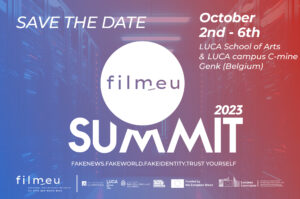
FilmEU and LUCA School of Arts invite you to our third FilmEU Summit from Monday October 2nd until Friday October 6th 2023, with public sessions on Wednesday and Thursday. A full week to connect and share expertise in the cultural and creative industries field with our consortium partners and beyond.
The subject of this summit ‘Fakenews.Fakeworld.Fakeidentity.Trust yourself.’, will broaden our horizons.
All timings are in CEST.
Programme:
Monday – 2nd October
C-mine Campus
13h00 WPs meetings (internal meetings)
Tuesday – 3rd October
C-mine Campus
10h00 FilmEU PMB Meeting (closed meeting)
13h30 Academic Council Meeting (closed meeting)
15h00 Welcoming Coffee
16h00 Official launch Summit – FilmEU Association – Vernissage Artistic Research Expo C-mine Cultural Centre – Designcentrum
18h00 Guided visit FilmEU Artistic Research Exhibition
Wednesday – 4th October
Thor Central
08h30 Welcoming Coffee
09h00 Opening Speeches
- Dr. Simon van Damme
- Professor Manuel José Damásio
09h15 Morning Plenary Session: Fakenews Fakeworld Fakeidentity
with keynote speakers
10h30 Coffee Break
11h00 Round Table Industry: Deepfake
11h40 Round Table Education: Artificial Intelligence
12h20 Round Table Student and Community Voices
13h00 Lunch Break
14h00 Afternoon session: Presentation FilmEU Toolkit
15h30 Coffee Break
16h00 Symposium Artistic Research
17h30 Walking Early Dinner
19h00 FilmEU Screening best of FilmEU
Thursday – 5th October
C-mine Crib – (closed sessions)
09h30 FilmEU+ Plenary
11h00 Coffee Break
11h30 FilmEU+ Breakout Sessions
C-mine Campus – (closed sessions)
13h00 Lunch Break
13h30 Campus C-mine Tour
14h00 Working Sessions FilmEU+
16h00 Outdoor Activity – Mine Visit and Bike Ride
19h00 Closing Dinner
Friday – 6th October
C-mine Campus (Closed sessions)
09h00 Morning Coffee and Break-out meetings
12h30 Farewell Lunch
Registration and Programme updates at: https://www.filmeu.eu/news-and-events/news/filmeu-summit-2023-luca-school-of-arts-genk-belgium
€12.8 Million Funding for FilmEU European University Alliance
Dún Laoghaire Institute of Art, Design and Technology is delighted to announce the official results of the 2023 Erasmus+ call to support the European Universities.
FilmEU, the European University dedicated to the cultural and creative industries, is thrilled to announce the allocation of €12.8 million in funding from the European Commission. This significant investment solidifies the European Union’s dedicated support for the FilmEU Alliance, marking a pivotal moment in the advancement of arts and culture education across Europe.
Responding to the call by the European Commission to deepen, expand, and intensify existing cooperation, the FilmEU Alliance is delighted to welcome four new partners, thereby expanding from its original consortium of four institutions to a formidable group of eight leading Higher Education Institutions (HEIs) across Europe. The Alliance, led by Lusófona University from Portugal, includes original consortium members Luca School of Arts in Belgium, IADT – Dún Laoghaire Institute of Art Design and Technology in Ireland and TLU – Tallinn University, in Estonia and welcomes new members VŠMU – Academy of Performing Arts in Slovakia, LMTA – The Lithuanian Academy of Music and Theatre, VIA University College in Denmark, and NATFA (National Academy for Theatre and Film Arts) – “Krustyo Sarafov” in Bulgaria. This enhanced partnership will consolidate the diverse expertise and disciplines represented within the cultural and creative industries, further strengthening Europe’s position as a global leader in education, research, and innovation in cultural and creative industries domains.
FilmEU is an extraordinary initiative unlike any other in the field of arts and culture. It unites a consortium of four institutions that have now grown to eight partners. This European Alliance for Film and Media Arts will revolutionise higher education in the sector by fostering collaboration, innovation, and the exchange of ideas in the screen arts. With the backing of Erasmus and the European Universities program, FilmEU is bridging institutions and countries, fostering a metamorphosis of the tertiary sector throughout the member states.
In its initial phase, FilmEU achieved remarkable milestones. Now, with the infusion of €12.8 million, the alliance is poised to create a lasting impact. Over the next decade, FilmEU envisions building a significant educational framework that will shape the landscape of screen arts in Europe and beyond. This initiative will have far-reaching impacts, not only within the partner institutions but also across the cultural and creative sectors, influencing the societal discourse on sustainability, inclusion, climate, research mobility, innovation, and digital transformation.
The core discipline of Film and Media, working alongside a diverse range of subject areas found throughout the participating Higher Education Institutions (HEIs), will benefit immensely from the programmatic approach of FilmEU. It will empower each partner to transcend their individual strengths, permeating external engagement and internal structures. FilmEU is not only shaping its own future but also preparing each member institution for the evolving national and European Higher Education sector. Much like the relationship between the EU itself and nation-states, the EU Universities will coexist harmoniously with home institutions, creating a mutually beneficial environment for all stakeholders.
Film, as an integral part of our cultural milieu, serves as a powerful medium for sharing ideas, emotions, and knowledge. With generous funding from the European Commission, FilmEU ensures that Europe can not only tell its own stories but also positions the creative industries at the forefront of economic and social prosperity. Moreover, FilmEU pushes the boundaries of research, innovation, and enterprise, leading the way in the age of imagination and fostering a virtuous society and economy.
FilmEU+ will build upon the success and achievements of the Alliance’s previous efforts, exploring innovative models for sustainable cooperation between the participating HEIs. By consolidating complementary programs in filmic arts and related fields, FilmEU+ aims to elevate Europe’s profile as a cutting-edge provider of education, research, and innovation in the cultural and creative industries.
FilmEU+ exemplifies the collaborative spirit of like-minded institutions with diverse cultural backgrounds. Embracing different approaches and cultures, the Alliance ensures that all voices are cherished and heard, particularly in the context of emerging technologies. By celebrating diversity, FilmEU+ offers an authentic and unique educational experience, promoting a broad spectrum of storytelling that transcends cultural boundaries.
With the European Commission’s significant investment, the FilmEU European University Alliance is poised to shape the future of arts and culture education, foster innovation, and collaboration, and create a lasting impact across Europe’s creative landscape.
Visit FilmEU website
SUBSCRIBE to our MAILING LIST
(scroll to the bottom of our homepage).
CHECK OUT Upcoming EVENTS
FOLLOW us on SOCIAL MEDIA
https://www.instagram.com/filmeualliance
https://www.facebook.com/filmeualliance
2nd FilmEU_RIT Summit
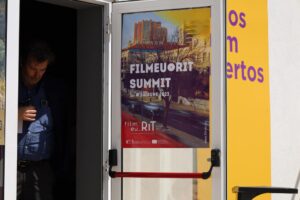
Between 31st May and 2nd June, our partners, Lusófona University (Portugal), hosted the 2nd FilmEU_RIT Summit. It was an opportunity for the FilmEu_RIT researchers to meet in person again, present their pilot projects and discuss the ongoing work. Three days were full of highlights, from the presentation of the artistic research being conducted by the transnational teams of the Alliance, to the master classes conducted by Catherine David, Teemu Maki and Sara Driver, who presented her film “Sleepwalk”.
On the second day of the Summit, the pilot teams presented the ongoing work. It was the first time, the FilmEU team saw some outputs. We started with Pilot 1 – The European Archive of Short Animation, led by IADt researchers. This project will produce a detailed state-of-the-art report identifying and recording relevant sources of information on the production and exhibition of short animated films, in small European countries. Another project with the participation of IADT researchers was Expanded Memories – Pilot 3.1 that had an interactive presentation. The project aims to experiment with hybrid forms of analogue-digital (animation) film to create objects of tertiary memory.
The Doctoral Summer Seminar had a full day dedicated to the PhD candidates and their presentations. Eight PhD candidates from the four institutions presented the ongoing research and received feedback from the specialists. The other seven students had the opportunity to present their research in a public poster session.
The Summit ended with the round table “From RIT to FilmEU+: FuturePerspectives around Research” with Manuel José Damásio, Daithí Mac Síthigh, Teet Teinemaa and Lies Van de Vijver.
The sessions with Catherine David, Teemu Maki and Sara Driver are available on the FilmEU Youtube channel.
ETIKETA - 2nd WORKSHOP - The Digital Format for the EU Label
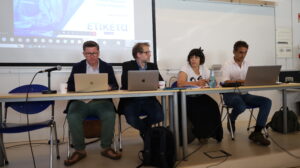
Last week, the Etiketa partners, stakeholders and a group of joint degree students participated in a hybrid Etikéta Focus Group on Future Models for European Degrees.
We gathered to discuss the relevance of a future degree label, the proposed criteria and the ongoing mapping of the existing and future degree labels.
FOCI (Future-proof Criteria for Innovative European Education) also introduced its workflow and project. The Etikéta project is all about collaboration with and learning from external partners.
FilmEU is hiring!
Job Information
FilmEU Assistant Professor | Ref. 20230516/001 | Lifelong learning, Digital humanities, Data visualization Media archaeology
Organisation/Company: COFAC
Department: FilmEU – The European Universities Alliance for Film and Media Arts
Researcher Profile: Recognised Researcher (R2)
Country: Portugal
Application Deadline: 2 Jul 2023 – 23:59 (Europe/Lisbon)
Type of Contract: Permanent
Job Status: Full-time
Hours Per Week: 35
Offer Starting Date: 1 Sep 2023
Is the job funded through the EU Research Framework Programme?: Not funded by an EU programme
Reference Number: 20230516/001
Is the Job related to staff position within a Research Infrastructure?: No
Offer Description
FilmEU (The European Universities Alliance for Film and Media Arts), is seeking a full time Ph.D. Assistant Professor and researcher, under the terms of the applicable legislation, with an Open-Ended Employment Contract. This position offers a unique opportunity to work in an international environment with valuable teaching and research experience.
The applicant needs to have a track record in one of the following areas of research:
- Data visualisation
- Digital humanities
- Lifelong learning
- Media Archaeology
Main Duties:
The work to be carried out will be:
- To design and lecture specialised classes;
- To participate in academic activities at all University levels;
- To participate in professional and community activities;
- To provide academic and career advising to students;
- To develop advanced and international research, within the scope of Lifelong learning; Digital humanities; Data visualisation; Media archaeology;
- To contribute to the promotion of the internationalisation of FilmEU;
- To lead and cooperate in application processes for competitive international funding;
- To collaborate in training activities in scientific research included in the scientific strategy of FilmEU.
Contractual terms:
- The gross base monthly salary depending on qualifications and work experience will range from €43,400 up to a maximum of €75,600 annual gross for a full-time position.
- The position of the Ph.D. assistant professor/researcher is made effective using an open-ended employment contract, under the Portuguese Labour Law;
- The tasks to be carried out in the fulfilment of this position are those considered in the scope of the FilmEU;
- The contract to be made is scheduled to begin on September, 1st 2023;
- The tasks comprehended in the object of the employment contract take place in such places deemed necessary to implement the assigned activities;
- This contract is granted for an indefinite period, being subject to a trial period of 5 years. The fulfilment of the objectives established in the work plan (teaching and scientific research) is mandatory and verified annually.
Requirements
Education Level: PhD or equivalent
Skills/Qualifications
The ideal candidate should have the following academic profile:
a) To be, at the deadline for submitting applications, the holder of a valid Doctoral degree, for more than 5 years in one of the disciplinary areas for which the competition is opened, or in a related field which, when combined with the scientific background, demonstrates the ability to work with centrality in one or more of the disciplinary areas for which the competition is opened;
b) Oral and written proficiency in English (B2);
c) Have participated in national and/or international R&D activities related to the mentioned areas;
d) Have authored relevant published work in international peer-reviewed journals (high-ranked magazines and journals indexed to SciMago);
e) Have previous lecturing experience and/or in the coordination of research projects in AI, Lifelong learning, Digital humanities, Data visualisation or Media archaeology fields;
f) Preferably, have previous experience in the coordination of researching projects in the proposal topics.
Languages: PORTUGUESE
Level: Good
Languages: ENGLISH
Level: Good
Years of Research Experience: 4 – 10
Internal Application form(s) needed
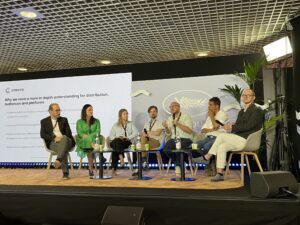
Crescine launched in Cannes 2023
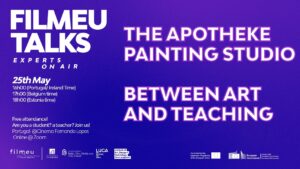
FilmEU Talks - Experts on Air + The Apotheke Painting Studio - Between Art and Teaching
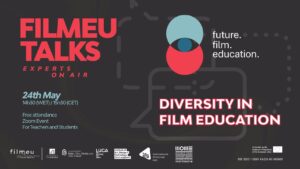
Massive Open Online Course (MOOC) “Diversity in Film & Media”
WHY SO SERIOUS? Teaching Comedy in Film Schools April 24th to 26th 2023
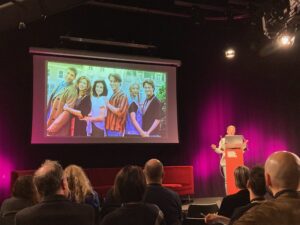
On April 24th-26th 2023, The National Film School at IADT, Dún Laoghaire hosted a conference on Teaching Comedy in Film Schools “Why So Serious?”. The event was held in Studio 1 on our campus in Dún Laoghaire, Ireland.
A GEECT Teaching Conference, hosted by IADT and supported by CILECT, FilmEU and NAHEMI brought together experts in comedy writing to share their insights and advise on how to teach comedy in film schools across the world.
Last FilmEU Cineclub this academic year (26th April )
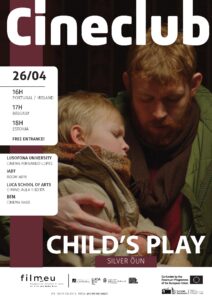
Join us April 26th for the last FilmEU CineClub this academic year. Hosted by our Estonian partners, BFM, three short graduation films will be screened.
Forgotten Summer Haze by Teresa Juksaar, tells a story about summer reunion, where childhood friends try to remember the details of what happened fifteen years ago, but their memories turn out to be different. A surreal journey begins to try to remember the event, but not everyone is honest on this journey.
Wishes from the Well by Alesja Suzdaltseva is a story of a man who has fallen between the cracks of life and has to find the missing pennies to buy medicine in the winter before the pharmacy closes. When begging doesn’t help, despair drives him to the bottom of the wishing well. However, curiosity brings a little boy to the well, whose wishes the man tries to fulfill for money.
Child´s Play by Silver Õun is about fathers Robert and Mart who teach their sons how to cut down trees to ensure the boys will grow into real men. But when fathers leave their children outside alone, an accident happens that no parent wants to see.
Wednesday 26.04.2023
Ireland and Portugal: 4-5:20 PM (IADT, A019).
Belgium: 5-6:20 PM
Estonia: 6-7:20 PM
Screening is followed by Q&A with the filmmakers.
C-accelerate meeting in Dublin
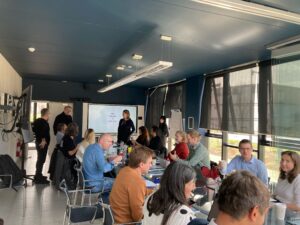
IADT FilmEU CineClub, The Quiet Girl screening, with Stephne Rennicks in presence.
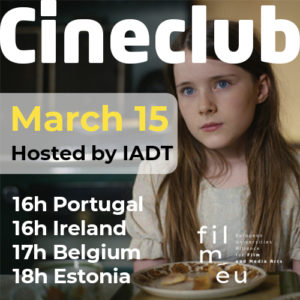
Join us for the #4 edition of FilmEU’s Cineclub this year. Hosted by IADT, simultaneously streamed at the FilmEU partner institutions. Next Wednesday, March 15th, we will screen The Quiet Girl directed by Colm Bairéad, the first Irish-language film to be nominated for an Oscar!
Screening will be followed by Q&A with the composer Stephen Rennicks.
Short synopsis:
Cáit is a nine year-old girl from an over- crowded, dysfunctional and impoverished family. Quietly struggling at school and at home, she has learnt to hide in plain sight from those around her. As summer arrives and her pregnant mother’s due date approaches, Cáit is sent to live with distant relatives. Without knowing when she will return home, she is left at the strangers’ house with only the clothes she is wearing. The Kinsellas, a middle-aged couple she has never met, dress the girl in what clothes they have. They are farming people, like her own, but hard-working and wanting for nothing, it seems. Despite a warm reception from the woman, Eibhlín, the man of the house, Seán, keeps his distance from Cáit and she from him, but over time, their strained relationship begins to deepen. Slowly, in the care of the Kinsellas, Cáit blossoms and discovers a new way of living. But in this house where affection grows and there are meant to be no secrets, she discovers one painful truth.
Join us at the IADT campus Wednesday 15th of March in room C030, 4pm.
Free attendance.
Visit www.filmeu.eu for more information. Or follow @filmeualliance for more updates.
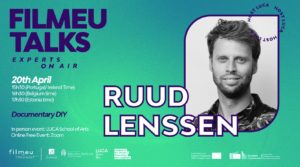
Next FilmEU Talks - experts on Air with Ruud Lenssen on the 20th of April
WHY SO SERIOUS? - Call for papers
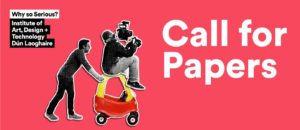
WHY SO SERIOUS? Teaching Comedy in Film Schools
April 24th to 26th 2023
The National Film School at IADT, Dun Laoghaire is hosting a conference on Teaching Comedy in Film Schools called “Why So Serious?”. The event will be held in Studio 1 on our campus in Dun Laoghaire, Ireland on April 24th to 26th 2023.
A GEECT Teaching Conference, hosted by IADT and supported by CILECT, FilmEU and NAHEMI will bring together, experts in comedy writing and ask them to contemplate and advise on how to teach comedy in film schools across the world.
Introduction
Comedy can provide an insight into the soul, it can speak truth to power or comfort us in our darkest moments. So why is teaching comedy in film schools not taken seriously? This conference will find out why. Bringing together comedians, writers, researchers and academics specialising in or curious about comedy, will gain new insights into methodologies for teaching and filmmaking in the comedic form.
We are looking for a mix of presentations, case studies, and roundtables which will explore techniques of how to teach comedy, how to develop comedic projects, how to tutor students in best practice and gain a deeper understanding into the nature of `writers’ rooms. This conference is about reshaping how comedy is approached and how it can become a pillar of film education.
Call for Contributions
We are looking for contributors who can address all aspects of teaching comedy. Some suggested topics are:
- Teaching comedy
- Case studies of comedy modules
- Writers room in the classroom
- How to structure and film comedy
- Comedy in pre-production, production, and post-production
- Economics of Comedy
- Pathways for graduates in the comedy industry
- Writing for television and cinema
- The future of comedy
- Best Practices / Best Kept Secrets
Deadlines
Please submit concrete suggestions (200 words), names of presenters (with contact details where possible) you believe could be both interesting and inspiring for all of us to whysoserious@staging.iadt.ie by March 1st, 2023 (extended deadline).
Where Are We?
Situated in Ireland, close to the port town of Dun Laoghaire, IADT is 12kms away from Dublin City Centre. Dun Laoghaire is a hub for culture and nature. Come enjoy the food, the sea and possibly a pint of Guinness.
Costs & Practicalities
Dates: Arrivals April 23rd, departures from April 26th (after lunch)
Delegate fees:
GEECT / CILECT full members €450 per delegate (full member schools in good standing may send up to two delegates, and candidate and partner members in good standing may send one delegate, at the subsidised rate).
CILECT members from other Regions (CARA, CAPA, CIBA or CNA) can apply for a Fee Waiver: please contact Stanislav Semerdjiev, (places are limited and are assigned on a first-come-first-served basis).
NAHEMI members who are not members of CILECT or GEECT €600
Delegate Full fee: €750 per delegate: non-members/members not in good standing and any additional delegates from member schools.
Conference fees include 3 night’s accommodation, lunches on conference days and a conference dinner.
Please register as soon as possible. And by March 10th, 2023
Official registration: https://www.surveymonkey.com/r/KRCTHZL
Conference website: www.whysoseriousconference.com
February 22, 2023: Cineclub hosted by LUCA School of Arts

On Wednesday February 22, LUCA organizes the 3rd edition of the FilmEU Cineclub of this academic year which will be organised in person at LUCA and simultaneously streamed at the FilmEU partner institutions.
Three filmmakers are invited to screen and talk about their films: Julie Verstraten with the animation film Inertia, Brahim Tall with Tukuleur and Géraldine Charpentier with Papa Zaza. Julie Verstraten and Brahim Tall are both LUCA alumni who both won the VAF Wildcard this year. Géraldine Charpentier is an animation film alumna of École nationale supérieure des arts visuels de La Cambre.
All three films deal with deeply intimate personal subject matter. Through dialogue we aim to take a closer look at their praxis and which knowledge they could share with our students.
Synopsis ‘Tukuleur’ by Brahim tall: Hair, posture and skin colour shift, intersect and alternate, creating a choreography of looks and poses based on representations throughout art history and pop culture. By making its central character ever changing, Tukuleur attempts to show how our gaze influences the interpretation of different bodies in different contexts. The film then shows the consequences of these gazes and their linked representations for the personal growth of the character, and their struggle to find a place between acceptance and otherness.
Synopsis ‘Inertia’ by Julie Verstraten: Inertia is about J, a young woman in her early twenties, who loses a loved one. Instead of standing still and reflecting on how this loss affects her, she resolutely looks the other way and suppresses emotions. A shadow manifests itself in her flat and slowly takes over her desk, covering her books and drawing materials. J acknowledges the presence but makes no attempt to ascertain its meaning. She keeps running away until she is forced to reflect.
Synopsis ‘Papa Zaza’ by Géraldine Charpentier: Fleur tells the story of the illness of her dad, Zaza, which disrupts her daily life and that of her brothers as they try to grow up and play, like any child. The disease is shown through a child’s eyes and voice. Here is a new perspective of a common situation: waiting for their father’s return from a hospital is disruptive for children too young to understand everything.
PROGRAMME
- Screening location (IADT):
- A019 (Atrium building)
- Programme:
- 16h – 18h
An Cailín Ciúin nominated for Academy Award for Best International Feature Film!
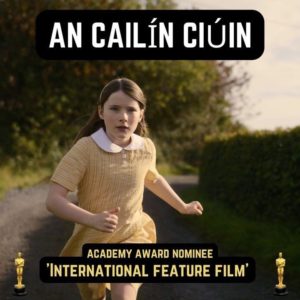
An Cailín Ciúin nominated for Academy Award for Best International Feature Film! This is the first time an Irish-language film has ever been nominated in this category, selected from 92 eligible countries. Several nominations for The Banshees of Inisherin and short film An Irish Goodbye, which was nominated for Best Live Action Short. Congratulations also to the Irish actors Paul Mescal, Colin Farrell, Brendan Gleeson, Kerry Condon and Barry Keoghan on their Academy Award nominations across the acting categories!
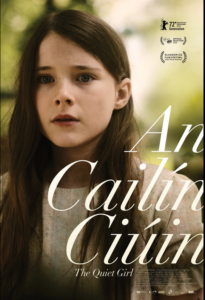
An Cailín Ciúin / The Quiet Girl as it makes history as the first Irish-language feature film to be shortlisted for the Oscars®!
C-ACCELERATE Conference in Tallinn with FilmEU
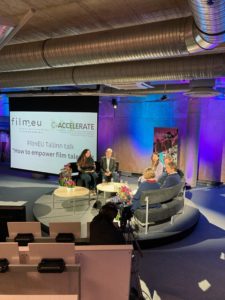
The FilmEU partners and the Aalto University/Aaltoes were together for the first C-ACCELERATE Conference in Tallinn (Estonia). C-ACCELERATE bring together researchers and students from the five partners and aims to increase the innovation and entrepreneurship capacity of higher education institutions in creative fields. Kino Eyes students presented their projects to teachers, researchers and specialists in the field of creative industries. The feedback and discussion around entrepreneurship studies in screen media was an important starting point for the second phase of the C-ACCELERATE project.
A public FilmEU panel discussion “How to empower film talents?” was streamed on the FilmEU Youtube channel. FilmEU representatives Manuel José Damásio, Barry Dignam, Marc Van De Walle and Elen Lotman, and a MA student Katniss Tung Cheng will reflect on their current talent support practices and policies and envision the directions to move toward. You can watch the session here.
During the second day we focused on Phase 2 preparations and the future steps. We were looking for startups to support, training more students/trainers to spread the entrepreneurial mindset and encourage innovation in our Higher Education Institutes. Read more about the project at: www.c-accelerate.eu
FilmEU Talks with Peter Zeitlinger
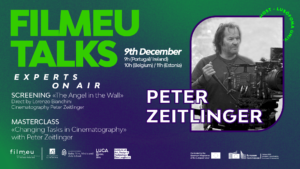
December 9th, join us for the last FilmEU Talks as a part of Lusófona University (Portugal) Audiovisual Week – a week dedicated to students being in contact with audiovisual specialists, researchers and professionals.
This will be an unique opportunity to watch the film “The Angel in the Wall”, directed by Lorenzo Bianchini and cinematography by Peter Zeitlinger. Recently, the film competed at the Camerimage Film Festival in Poland. The film is a great case study and it will be followed by a masterclass with the cinematographer Peter Zeitlinger.
FilmEU Talks with Nan Goldin

December 5th, join us for the first FilmEU Talks as a part of Lusófona University (Portugal) Audiovisual Week – a week dedicated to students being in contact with audiovisual specialists, researchers and professionals.
Lusofona University will host filmmaker and photographer Nan Goldin for a special masterclass with students and professors from the Department of Cinema and Media Arts.
Nancy (Nan) Goldin, born September 12, 1953, is an American photographer and activist. Her work often explores LGBT subcultures, moments of intimacy, the HIV/AIDS crisis, and the opioid epidemic. Her most notable work is The Ballad of Sexual Dependency (1986). The monograph documents the post-Stonewall, gay subculture and includes Goldin’s family and friends. She is a founding member of the advocacy group P.A.I.N. (Prescription Addiction Intervention Now).[1] She lives and works in New York City, Berlin, and Paris.
Join us for the live broadcast, December 5th, at 3:00pm, room C026.
Life, VR and the Metaverse
FilmEU Talks with Lucija Mrzljak
Second edition of FilmEU’s Cineclub
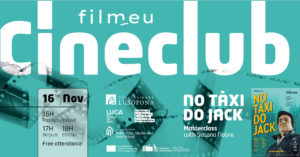
Join us for the Portuguese edition of FilmEU’s Cineclub. Berlinale Forum and Visions du Reel 2021, fascinating documentary about an ex New York cab driver, who witnessed numerous Wall Street crashes.
It will take place Wednesday the 16th of November in room A019, 4pm.
No Táxi do Jack / Jack’s Ride by Susana Nobre
At 63 years old and almost retired, Joaquim is forced to follow job centre rules so he can collect unemployment benefits. Despite knowing that he will never return to active life, he must go from company to company asking for stamps to attest that he is looking for work. In these trips he reminisces about his life as an immigrant in the U.S., where he worked as a cab driver in New York and witnessed numerous Wall Street crashes.
Visit www.filmeu.eu for more information. Or follow @filmeualliance for more updates.
Erasmus Mundus of the FilmEU alliance are open
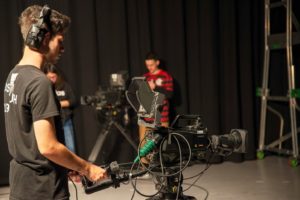
Ideation week in Brussels
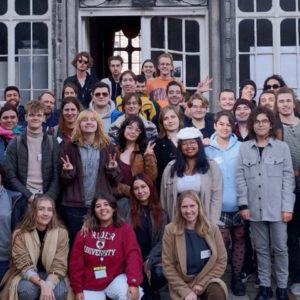
FilmEU represented at CILECT
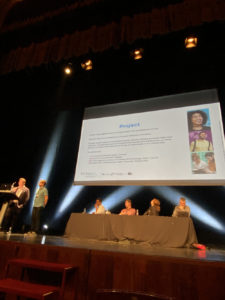
This year, and finally live, the CILECT congress focused its talks on Teaching Audiovisual Media Challenges & Chances.
FilmEU was very well represented by Barry Dignam and Marc Van De Walle, who took the opportunity to share some of our own experiences, challenges, and chances of setting up a European Alliance of Film Schools.
Filipe Vale and Júlio Alves presented “Reversed Blow-up – Using “Stories” as a Pedagogical Strategy in Film Education”, where they shared their experience in applying the Samsara Method, a common pedagogical method that FilmEU is implementing across the institutions, and how the results are being impressive. Read more about the Samsara model here.
CILECT Congress is one of the best stages to get to know how Film Schools across the world are evolving and responding to the many challenges the world is living.
First edition of FilmEU’s Cineclub
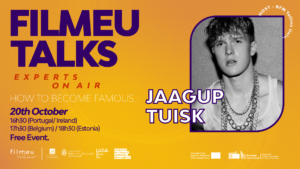
FilmEU Talks are back. BFM (Tallinn University) will host talk 'On how to become famous' with Jaagup Tuisk.
FilmEU research artistic published on International Journal of Creative Media Research
A publication about the artistic research of FilmEU was published on the International Journal of Creative Media Research, an interdisciplinary, peer-reviewed and open access academic journal devoted to pushing forward the approaches to and possibilities for publishing creative media-based research. Founded in 2018, the journal is hosted by The Centre for Media Research based at Bath Spa University.
FilmEU opportunities and challenges: Mapping a Sustainable Support Model for Practice-based Researchers, Supervisors and Examiners, is a cooperation between Érica Faleiro Rodrigues (CICANT, Lusófona University/FILMEU), Deidre O´Toole (IADT/FILMEU) and Manuel José Damásio (CICANT, Lusófona University/FILMEU)
Abstract
This research statement complements the podcast with the same title and is construed as a stepping stone towards a sustainable support model for practice based researchers, supervisors and examiners within the FilmEU alliance and, most importantly, beyond it, opening up the debate on the opportunities and challenges facing the topic. For this task, four relevant players from the artistic research arena were interviewed: Till Ansgar Baumhauer, Nico Carpentier, Michelle Teran and Florian Cramer. FilmEU includes Lusófona University, Portugal, Baltic Film and Media School, Estonia, LUCA, Belgium, and IADT, Ireland. In order to create a model with long-term impact for practice and artistic-based research, the alliance is pursuing a common and transdisciplinary research culture on artistic research within the field of Film and Media Arts. A major hurdle identified by the alliance is the upskilling of practitioners to ensure they have the skills and knowledge necessary to perform and supervise practice-based research. Many potential candidates and supervisors are already distinguished within the worlds of practice or academia; hence, the next step will be creating a bridge between practitioners and researchers. FilmEU will have to provide the adequate technical resources and expertise to guide researchers through this transition from practitioner to practitioner-researcher and to ensure that the work created achieves a professional standard.
Full article here.
Campus of the European Universities
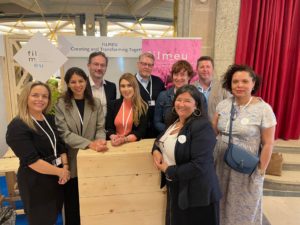
30th June 2022, the FilmEU team were present at the Campus of the European Universities in Versailles, along with the representatives of other 41 higher education alliances.
FilmEU Team had the opportunity to meet with the representatives, staff and students of all European Universities Alliances and had fruitful discussions on different approaches and challenges the alliances are dealing with. FilmEU representatives had also a chance to meet with the French Minister for Higher Education and Research Sylvie Retailleau.
The Campus of the European Universities was organised by the French Presidency in the European Commission. It was a great opportunity for networking and getting to know colleagues from other alliances.
FilmEU wins an EIT project
The European Institute of Innovation and Technology (EIT) announced the 26 winning consortia selected to take part in the EIT HEI Initiative. The FilmEU Alliance is a full partner in the C-ACCELERATE project, coordinated by IDBM and Aalto University. The C-Accelerate project aims to accelerate the role of creative communities through the exploration of entrepreneurial education and radical creativity within European education. The approval of C-Accelerate is a unique opportunity to boost the innovation capacity of our institutions.
Read more here.
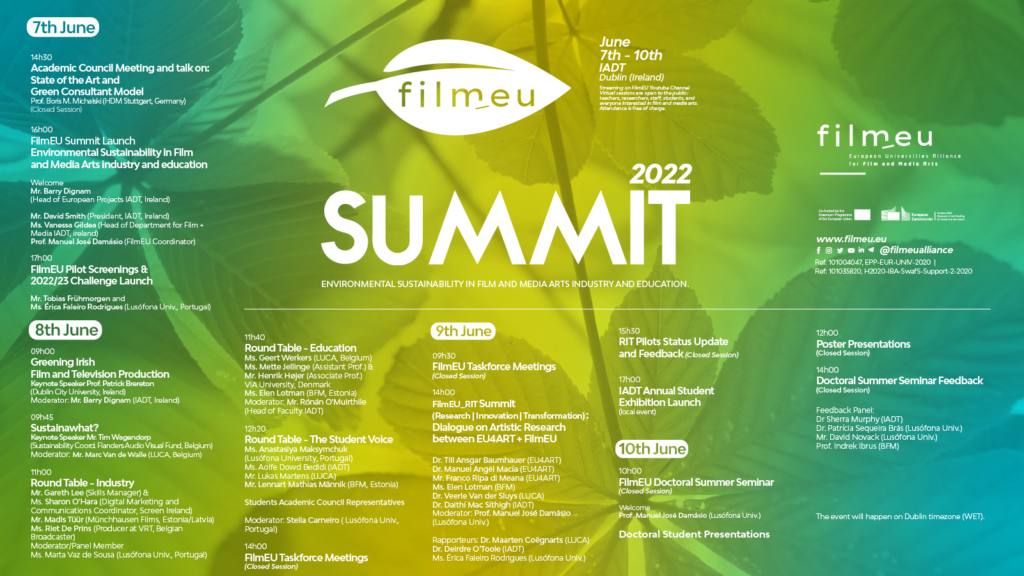
Dublin FilmEU Summit (7-10th June)
Creative Process of Directing and Writing for Preschool Animation
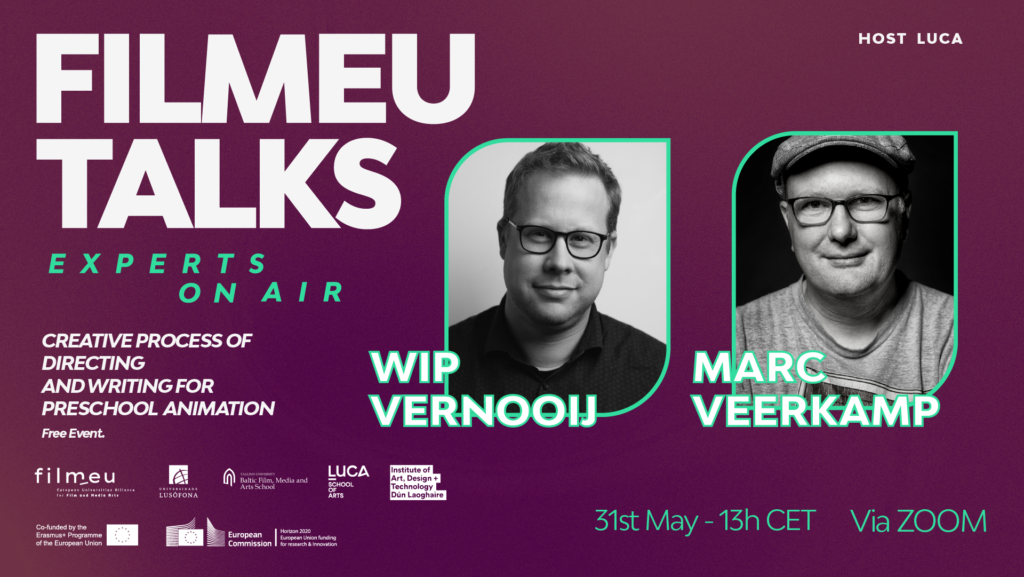
Wip & Marc will talk to us about their experience in the creative process of directing and writing for Preschool animation. Directing and writing the commercial preschool animation film ‘Two Tiny Toddlers’ during the pandemic also brought some new insights and challenges. They will provide us with some insights into this creative process.
Wip Vernooij (38) is a director, storyboard artist and animator, who most recently directed his second feature ‘Two Tiny Toddlers’, which will see a Dutch and Belgium release in 2022. It is the first 3D animated family film coming from the Netherlands.
Wip Vernooij has been named one of the Rising Stars of 2022 by the American magazine Animation Magazine!!! There he is, among people working at PIXAR and DreamWorks. Wip is someone who can make great strides on his own within narrow budgetary margins.
Mid 00’s Wip started as an intern at the animation studio Lawson & Whatshisname, then one of only a very few studios in the Netherlands. Soon after he moved to London and studied traditional hand-drawn character animation after which he remained in the UK to work on a variety of projects as an animator and compositor for educational games, commercials and music videos. In 2013 Wip debuted as director on a 2D animated feature called ‘Moshi Monsters the Movie’. He has since been involved in a number of TV-series and developments for young audiences as storyboard artist, series- and episodic director. Such as Wellie Wishers (Mattel), Fox & Hare (Submarine) and Dr. Panda (Dr. Panda)
Marc Veerkamp (Alkmaar, 1971) studied journalism and screenwriting. He started out as a journalist specializing in pedagogical subjects. During his career he shifted his focus to fiction. Nowadays Veerkamp mainly writes for film, television and theater. He was part of the writing team of SESAMSTRAAT for over 17 years. After that he also wrote for other Dutch youth series, such as HET ZANDKASTEEL and VRIJLAND.
He regularly works on animation projects. He also wrote, for the NTR-series GEORGE & PAUL, the Telemovie DE TAND DES TIJDS and the feature film ‘Two Tiny Toddlers’.
As a theater writer Veerkamp works for both children (e.g. RAAD EENS HOEVEEL IK VAN JE HOU) and adults (e.g. MA, based on the book of the same name by Hugo Borst).
He also published a children’s novel about KING ARTHUR and the picture book BEER IS NOOIT ALLEEN with illustrator Jeska Verstegen. Together with writer Bart Juttmann he wrote the yet-to-be-published book EN HET WOORD WERD BEELD, in which the writing process of 50 classic films and series is described.
The event is free, register here.
Navigating the Festival Circuit
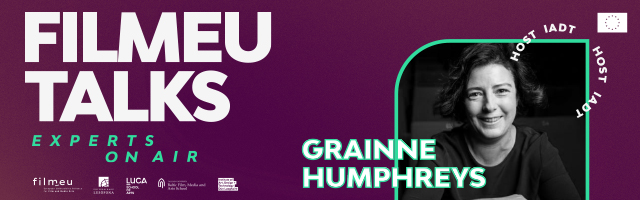
Grainne Humphreys is Festival Director of the Dublin International Film Festival since 2008. She started her career working with young audiences with the Junior Dublin Film Festival in 1994 and she has worked in film programming for over twenty five years. In 1995, she joined the IFI as Education Officer and expanded her role to include special seasons including a focus on the film work of diverse figures such as Andy Warhol, Agnes Varda and Harold Pinter. She was director of both the Stranger Than Fiction Documentary Festival and the Dublin French Film Festival from 2002- 2007. Among other projects, she co-edited Ireland into Film, a series of publications on Irish Cinema. She teaches a course on Film Distribution & Exhibition at Griffith College Dublin as well as Film Programming at University College Dublin.
Read more:
https://www.filmeu.eu/news-and-events/filmeu-talks
Follow FilmEU on social media:
@filmeualliance
Olga Lucovnicova - From being a student to an awarded filmmaker in one year: Challenges of First-Person Filmmaking

Olga Lucovnicova (Moldova, 1991) is a Belgium based documentary filmmaker and aspiring researcher in the field of audiovisual arts. She studied six years of cinematography at the Academy of Arts of Moldova and two years of documentary filmmaking at DocNomads, an Erasmus Mundus Joint Master Program delivered by a consortium of three prominent European universities across three countries: Portugal, Hungary and Belgium. Currently, Olga pursues her studies in film at the doctoral school at KU Leuven University. She was awarded an FWO (The Research Foundation – Flanders) fellowship for fundamental research for her personal doctoral research project on post-memory in the post-Soviet society and its research through first-person documentary film. Olga moved to Belgium in September 2019 to pursue her studies at LUCA School of Arts. Her graduation film “My Uncle Tudor” produced in Belgium, premiered in Berlinale in 2021 and was awarded the Golden Bear. “My Uncle Tudor” also won the European Film Academy Award, which is the European equivalent of the Oscar. The film travelled to over 40 film festivals and was awarded many important awards like the Golden Chair for Best Short Documentary at Norwegian FF, Best Short Documentary award at Ismailia IFF in Egypt, Big Stamp for Best Short Film at the ZagrebDox FF in Croatia, Best European Short at Sarajevo FF in Bosnia and Herzegovina, Best Director at Astra FF in Romania, Best Short Documentary at Guanajuato IFF in Mexico and many others.
Olga is a member of The European Film Academy and Moldavian Union of Cinematographers (MUC).
Read more:
https://www.filmeu.eu/initiatives-and-events/filmeu-talks-experts-on-air/
The event is free, but registration is mandatory. link
Dr Vejune Zemaityte - Cultural data analytics for understanding today’s cinema – 10th May 13H CET

Dr Vejune Zemaityte is Senior Research Fellow at the ERA Chair for Cultural Data Analytics in the Baltic Film, Media and Arts School at Tallinn University, Estonia. Vejune uses computational data analysis and visualisation techniques including Social Network Analysis to study global film industries, with a primary focus on cultural and gender diversity. Her work is interdisciplinary, data-driven, and industry-facing, often performed in collaboration with external partners such as Festival de Cannes, Women in Motion, or the Australian Cinematographers Society.
With ever-increasing amounts of data available about the global film industries, how do we as researchers select the important questions to pursue and the appropriate methodologies to adopt in order to answer them? In this talk, Vejune Zemaityte draws upon her experience of working as part of multidisciplinary research groups, as well as on industry-facing research collaborations, to discuss the nature of data-driven work concerning diversity and global cinema.
The event is free! Register here.
FilmEU Cineclub
Cineclub is where four film nights will be organized throughout the academic year 2021-2022. Each partner of the FilmEU alliance will organize a night where students and staff can watch a film that will take place simultaneously at the four institutions. These screenings will take place on the 20th of October, 10th of November and the 9th of February and March. Students will not only watch an international film but they will also get a chance to participate in a masterclass with a question and answers session with guest speakers. The first film Vitalina Varela is Portuguese and the Director Pedro Costa will be available for discussion after the show.
FilmEU Cineclub - Wednesday 16th March
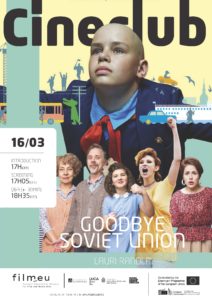
Wednesday the 16th of March in room A021 Cineclub was held. This time the Cineclub will be held by Baltic Film Media and Arts School (BFM) https://www.tlu.ee/en/bfm
Goodbye Soviet Union is a first feature of director Lauri Randla, based loosely on his childhood. The film was released during Covid cinema-closures, but still managed to become the most seen Estonian film in Finnish cinemas. It went on to win multiple awards and A-list festival nominations, including Camerimage Golden Frog nomination, Tallinn Black Nights Festival Audience Award and many others.
Johannes is born into an Ingrian-Finnish family in the Estonian Soviet Republic. When his mother leaves for Finland, and he’s left to be raised by his grandparents, Johannes is forced to face life on his own. He falls deeply in love with his classmate Vera, takes risks, gets into fights, and gets punished. All the while, in the background, the Evil Empire collapses. As the Lenins fall and the Barbie dolls take over, the crocodile Genas and the Moskvitches are forced to step aside, leaving the road to the West wide open. Lauri Randla’s Goodbye, Soviet Union is a comedy about the adventures of the eccentric Tarkkinen family in the last days of the Soviet Union.
The screening will be followed by Q&A with Elen Lotman, the cinematographer of Goodbye Soviet Union.
———————————————————-
FilmEU Cineclub - Wednesday 16th February

The next FilmEU Cineclub will be held by LUCA School of Arts on 16th February, 17h (CET).
We are proud to present an all-female edition! We will screen 5 animated short films from 5 different directors. Subsequently, all 5 directors will be present at LUCA for a Q&A open for all students and streaming for all FilmEU Schools!!!
The first film is by Sine Öziblige with #21x0x0! 21x0x0 is a surreal and humorous reflection of the 21st century. It depicts a girl and her online search for love in times of social media, speed-dating, cyberlove, hipster culture and post-net attitudes.
The second is Juliette by Lora D’Addazio! Lora takes us on a dark and twisted car ride in erotic animated horror short.
The third is Nienke Deutz with Bloeistraat 11! Inseparable best friends spend their last summer holiday of childhood amusing themselves around the house. As summer progresses, an awkwardness descends on their friendship. Puberty seems determined to interrupt their bond.
The fourth is Amours Libres by Emily Worms! Amours Libres is about two friends who tell us their way of loving freely. It’s a tale of polyamory and politics.
Finally the fifth is Joke Van Den Hof with Mamada Perdida! “A melting paradise with a love game of two in it, who lose themselves in the passion of being each other’s first love.”
Location:
Cinema Fernando Lopes (Lusófona University)
Campus Sint-Lukas, C-3.17 (LUCA School of Arts)
IADT Dun Laoghaire
Tallinn University
FilmEU Cineclub - Wednesday 10th November
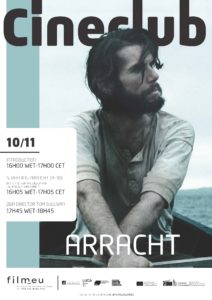
Cineclub #2 is taking place on Wednesday the 10th of November. Four film nights are being organized throughout the academic year 2021-2022. Each partner of the FilmEU alliance invites students and staff to watch a film that will take place simultaneously at the four institutions. Students will not only watch an international film but they will also get a chance to participate in a masterclass with a question and answers session with guest speakers. The second film of this series, is the Irish produced film Arracht and the Director Tom Sullivan will be available for discussion after the show.
FilmEU Cineclub - Wednesday 20th October
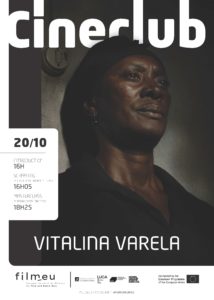
Cineclub is where four film nights will be organized throughout the academic year 2021-2022. Each partner of the FilmEU alliance will organize a night where students and staff can watch a film that will take place simultaneously at the four institutions. These screenings will take place on the 20th of October, 10th of November and the 9th of February and March. Students will not only watch an international film but they will also get a chance to participate in a masterclass with a question and answers session with guest speakers. The first film Vitalina Varela is Portuguese and the Director Pedro Costa will be available for discussion after the show.
FilmEU Talks - Experts on Air!
Experts on-Air is a new initiative aiming at reinforcing this diversity and openness by inviting experts in different domains of film and the media arts to present and discuss with us their achievements and experiences and the lessons they entail. These talks will reinforce our ability to connect to society and others and more importantly it will foster the ideals of collaboration and mutual reinforcement that shape FilmEU. Let the talks begin!
Ruben Vandenborre – My path after graduation: On becoming a professional filmmaker- 3rd May 2022

Ruben Vandenborre is a Flemish screenwriter and director and a graduate of The Luca School of Arts. After graduating with his short film ‘Vriend van Goud’, he gained experience as a producer at Woestijnvis and on the set of fiction productions such as Gent-West.
His heart belongs to the children and family genre and he has written the screenplays for the Flemish-Dutch Netflix Christmas films ‘The Claus Family’, ‘The Claus Family 2’ and ‘The Claus Family 3’. He also directed the second movie and start shooting the third next July.
Besides that, he’s also the producer of ‘Hacked’, the first youth series of his production company Dingie, which won the Short form competition at Cannes.
Emer Reynolds- Telling stories from fact to fiction- 26th April 2022
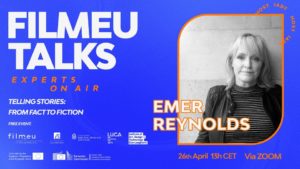
Emer Reynolds is an Emmy award-winning Director and Film Editor, based in Dublin, Ireland.
Having studied Theoretical Physics in Trinity College, Dublin, Emer enjoyed a successful and multi-award winning 20 year career as a Film Editor, spanning features, TV Drama and documentaries, before transitioning into directing.
THE FARTHEST, her multi-awarded feature documentary on the Voyager spacecraft, won the 2018 EMMY for OUTSTANDING SCIENCE AND TECHNOLOGY DOCUMENTARY and the prestigious 2018 National Academy of Sciences Communication Award.
Emer’s debut feature documentary, the Grierson nominated HERE WAS CUBA – which she co- directed with John Murray – tells the story of the Cuban Missile Crisis, and garnered widespread acclaim for its riveting and visceral storytelling.
Her critically acclaimed third feature documentary SONGS FOR WHILE I’M AWAY – a poetic, celebratory and intimate look at the life and work of iconic Thin Lizzy frontman, Philip Lynott – has just enjoyed a wide international cinema release and was recently broadcast on BBC2.
Emer has just completed her debut narrative feature JOYRIDE written by Ailbhe Keogan, which stars Oscar-winner Olivia Colman alongside newcomer Charlie Reid, and is due for cinema release in Summer ’22. Her next film project, an adaptation of passionate novel MONTPELIER PARADE by Dubliner Karl Geary, is slated for shoot in Winter ‘22.
Joachim Vleminckx - Creating Believable Game Worlds – 5th April 2022

Joachim Vleminckx is guiding the art team through the deep dungeons of game creation since 2014 for Larian Studios. Larian Studios was a small game company in Belgium till their first crowdfunded success, Divinity: Original Sin, won over 150 awards and nominations and grow out of one of the best RPG game studios in the world.
Joachim worked as an Environment artist for almost 10 years before he started to work as an ART Director for the successful game Divinity: Original Sin 2. This game was launched with a 93 Metacritic rating, as well as over 160 awards (Including the Bafta for Best Multiplayer Game) and counting! Thanks to the success of these two games, the Larian family has grown to over 300 people around the world, working in Ghent, Quebec, Dublin, Kuala Lumpur, Guildford and Barcelona studios.
Currently Joachim is working on the game, Baldur’s Gate 3 that is in Early Access.
Making any game is an adventure. Joachim will talk about his art adventures in creating believable game worlds for international RPG games.
Eimear Noone- Conducting the Symphony – 29th March 2022
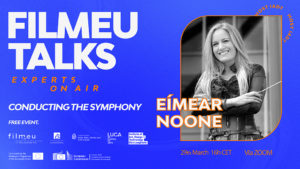
Eímear Noone is a Dublin based conductor and award-winning Irish composer, composing extensively for film and videogame. As one of the world’s premier composers of games scores, Eímear is responsible for some of the most enduring soundscapes on World of Warcraft and other best-selling video games. Through her music on World of WarCraft, Eímear’s music has reached over a 100 million people and continually inspired players to invent and build new worlds for nearly 15 years. Her composition portfolio of 26 film and video-game titles have received multiple industry accolades including the “Hollywood Music in Media Award” for “Best Video Game Score”.Recently, Eímear composed the score for the animated feature film, ‘Two by Two: Overboard’, which topped the UK Box Office in October 2020. She has also worked on film scores for directors such as Gus Van Sant and Joe Dante, orchestrating for Oscar nominee Javier Navarrette (composer of “Pan’s Labyrinth”) creating haunting music for thrillers Mirrors and The Hole.Alongside composing, Eímear conducts orchestras worldwide – notably in 2020, Eímear made history by becoming the first female conductor to perform at the 92nd Academy Award’s ceremony.As a leading conductor of video game programmes, Eimear has conducted orchestras including Royal Philharmonic Orchestra, BBC Concert Orchestra, Singapore Symphony Orchestra and Danish National Symphony and she was chosen by Nintendo to conduct the first ever 3D filming of a game score and has recorded game scores for Sony Interactive. She has also toured as conductor for The Legend of Zelda, Symphony of the Goddesses, a full four-movement symphony created from the themes from this iconic videogame. Eímear was invited to conduct on the 25th Anniversary recording, which set industry records for soundtrack sales.
Governing the night-time city: The rise of night mayors. 22nd March 2022

As one of the first night mayors in the world, Mirik Milan has played an instrumental role in the reshaping of Amsterdam’s nightlife scene into one of the most vibrant and economically robust in the world, and his innovative position is been replicated in major cities around the world, like New York, Paris and London.
Nowadays Mirik Milan is a nightlife consultant, co-founder of VibeLab and author of the paper ‘Governing the night-time city: The rise of night mayors as a new form of urban governance after dark’. In January 2020 the journal Urban Studies released this first qualitative study on night mayors around the world. To date 65 cities installed a similar position in their cities in the recent years.
VibeLab is a purpose drive consultancy agency, developing strategies and trailblazing a largely untapped research field: life at night. In 2017 VibeLab launched a research methodology named Creative Footprint (CFP) for measuring creativity in cities at night.
The CFP is a data drive initiative that maps and indexes creative space to measure the impact of nightlife and cultural activity on cities globally. The methodology goes beyond economic impact, prioritizing original content, interdisciplinary connections, and cross-functional spaces for thriving local scenes. CFP empowers grassroots movements that fuel innovations for the creative and cultural industries. The study benchmarks cities to better understand the health and mechanisms behind successful creative places. CFP was conducted data mappings of Berlin, New York, Tokyo and Stockholm is forthcoming.
In 2020 VibeLab launched an online hub of international knowledge exchange, for anyone interested in the planning and protection of life after dark named: Nightime.org.
The event is free, but registration is necessary: Link here
Post-crisis Cinema Culture - 15th March 2022
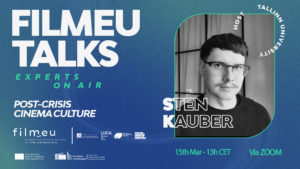
STEN KAUBER / Junior Research Fellow/ Freelance Film Critic /Centre of Excellence in Media Innovation and Digital Culture /Tallinn University
What will cinema-going look like after the crisis and what will lure audiences back to cinema theatres? The talk envisions future elements of cinema culture by drawing on the speaker’s ongoing PhD research project, which deals with how film experiences are being shaped by production, distribution, exhibition, and consumption practices.
Sten is currently finishing his PhD dissertation, which examines Estonian film audiences multidimensionally by focusing on the practices that shape and encourage film consumption. His research interests include audience studies, production studies, film culture, film criticism, and material culture.
The event is free, but registration is mandatory. Link here.
Sustainawhat? - 8th March 2022
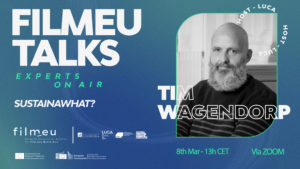
TIM WAGENDORP | Sustainability coordinator | Flanders Audiovisual Fund | Belgium
“Having an environmental background, I feel somehow atypical in the audio-visual sector.” After working as an environmental scientist and policy expert for a federation of reuse companies, Tim Wagendorp has been the sustainability coordinator at the VAF since March 2017. “My main focus is on VAF-supported film and media productions, but I also raise awareness at other VAF-related areas like at physical cinemas, during the screenwriting process, games, animation and in education. We use the Sustainable Development Goals as a moral compass for our work. We exchange our knowledge as much as possible and play an active role within Green Screen (and EURECA), Cineregio and EFAD. ”
The event is free, but registration is mandatory. Link here
The Power of Collaboration – 1st March 2022
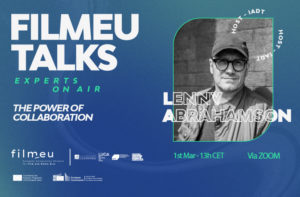
Lenny Abrahamson is one of Ireland’s best known and respected film and television directors. He is known for directing such praised independent films as Adam & Paul (2004), Garage (2007), What Richard Did (2012), and Frank (2014).
In 2015, he received widespread recognition for directing Room, based on the novel of the same name by Emma Donoghue. The film received four nominations at the 88th Academy Awards including Best Picture and Best Director for Abrahamson. In 2020, he directed six episodes of and executive produced the television series Normal People, for which he was nominated for the Primetime Emmy Award for Outstanding Directing for a Limited Series.
The event is free, but registration is mandatory. Link here.
The Future of Film is Multicolour – 22nd February 2022
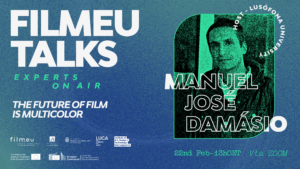
Manuel José Damásio holds a Ph.D in Media studies by the Universidade Nova de Lisboa and a tenure by Universidade do Minho. He is an Associate Professor and the Head of the Film and Media Arts Department at Lusófona University. He holds a vast experience in consulting and production concerning several areas of the field of audiovisual and multimedia production. He is the author of several papers and chapters in international peer-reviewed publications and was the principal investigator in numerous international R&D projects. He is the chair of GEECT – the European association of film and media schools and a member of the board of CILECT – International association of film and media schools. He is the coordinator of FILMEU.
The event is free, but registration is mandatory. Link here.
Creative Futures Academy – Animation@StoryLAB
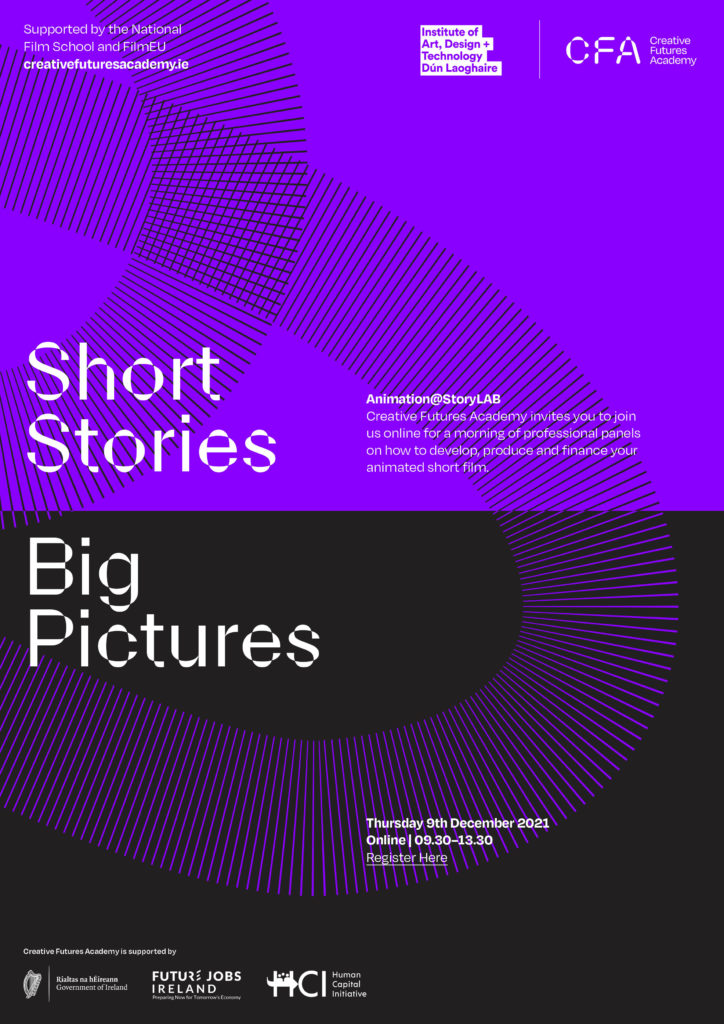
FilmEU Summit 2021
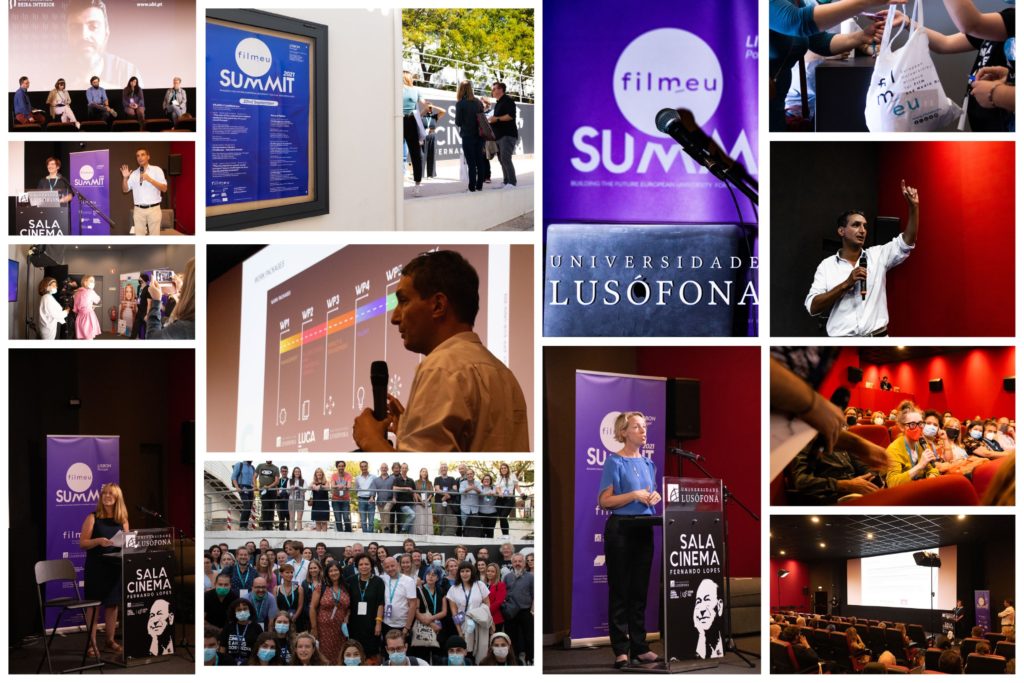
Barry Dignam | Head of Department of European Projects
“The summit was a delight and a huge success. Not only did we get to meet our colleagues face to face for the first time, but we also had the opportunity to reach out and discuss some of the most pressing issues facing film education and indeed society as we look toward a post-pandemic Europe”.
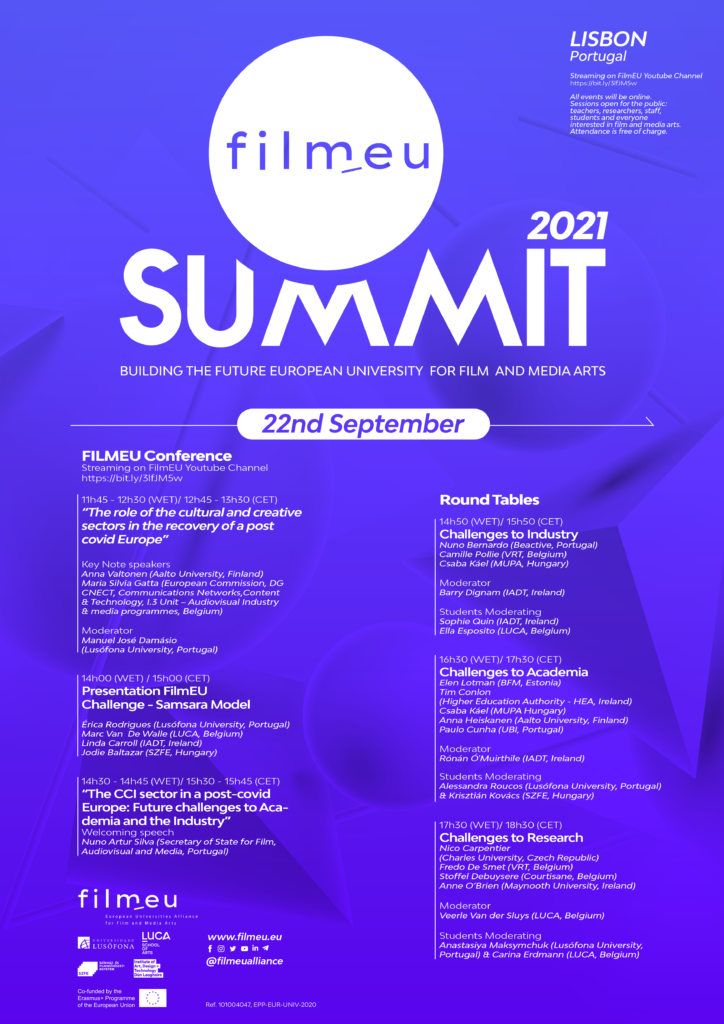
To highlight the alliance’s main objectives and future plans, a FilmEU summit is organized every year. The summit takes place in September and is symbolically linked to the start of a new and fruitful academic year. Last year’s summit was organized online from September 21 until September 24 and was open to the public on the 22nd. The day consisted of talks and roundtable discussions revolving around the challenges that arise within the field of film and media in a (post-) covid world and how to tackle them. All speakers were experts in their respective domains.
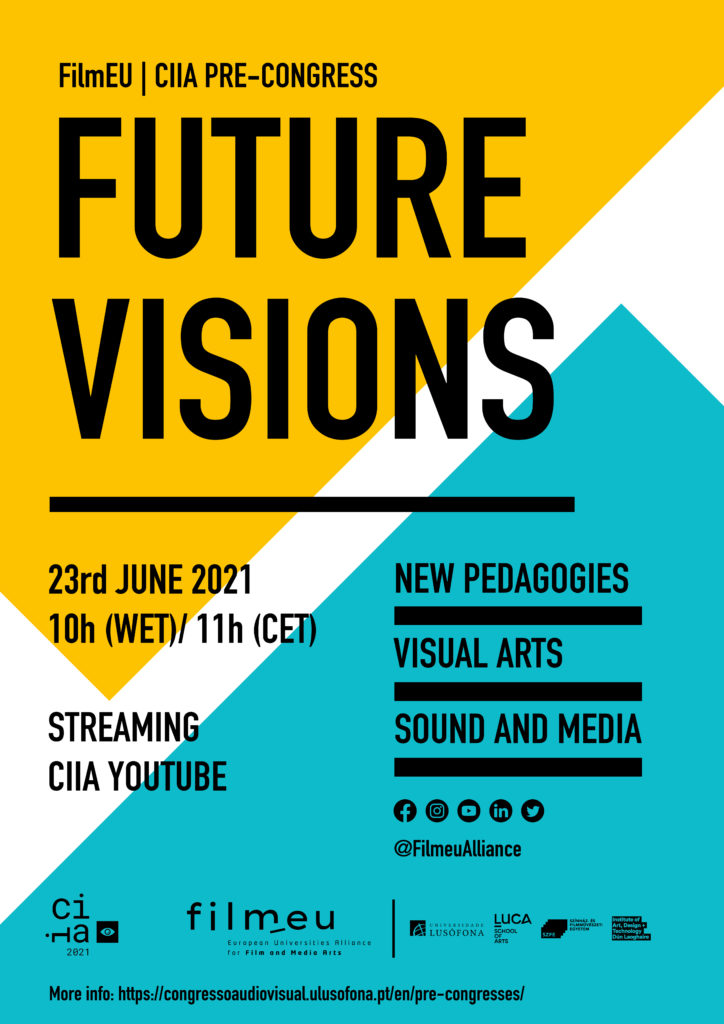
“IADT is delighted to have been selected to help shape the vision of what the university of the future will look like. Along with our international partners we have been awarded funding of €5m to create the concept of FilmEU, a European University of Film and Media Arts.
Involving students, staff and industry stakeholders we will spend the next three years finding best practice within our institutions and across the globe to synthesise and pilot innovations that encompass all spheres of activity of a modern university.”
Barry Dignam, Head of the Department of European Projects
National Film School IADT
European Universities Initiative
)
Together, we collaborate around the common objective of jointly promoting high-level education, innovation and research activities in the multidisciplinary field of Film and Media Arts and consolidate the central role of Europe as a world leader in the creative fields.
FilmEU is focused on long-term strategic collaboration and our mission is to create a European University that is a model for collaboration in the fields of the Arts and the creative industries and that will greatly contribute to Europe’s leading role as a provider of education and research in the creative and artistic areas.
About FilmEU
FilmEU believes Europe has all the right leads needed in order to play a key role at international level in the area of Film and Media Arts. These include the relevance of Europe’s historical filmic cultural heritage, the dynamism of its production sector, which services all creative outputs from pure entertainment to the highest artistic formats, and the unique educational offer already in place.
We share the belief that cinema and media arts lie at the centre of social transformations and economic growth which the creative sector can spur if proper collaborative networks are successfully erected. Building on more than a decade of successful cooperation, we envision positioning ourselves as key players in driving education, innovation and research in Film and Media Arts and in promoting the central role the creative and cultural industries can and should have in our societies.
In order to do so, FilmEU institutions will deepen their existing collaboration. We will develop and implement a joint governance model that engages all stakeholders including students. We will reinforce mobility within the Alliance via the implementation of digital tools. We will develop new joint programmes while harmonising the curriculum and pedagogical approaches of existing ones. We will increase the sharing of resources, services and staff in the context of joint education and research activities. Moreover, we will jointly work in order to increase the overall capacity and competitiveness of our institutions.
Meet the IADT FilmEU Team
Management Team
Barry Dignam | Head of Department of European Projects
Rónán O’Muirthile | Head of Faculty of Film, Art & Creative Technology

Linda Carroll | European Projects Coordinator
Academic Leads
Conor Brennan
Damien Byrne
Deirdre O’Toole
David Quin
Working Group
Paul Curran
Claire McGing
Maurice Coen
Colm Hennessy
Elena Somoza
Ruth Barry
Diog O’Connoll
Brian Carty
Stephen Boyd
Michael Connerty
Frank Reid
Key Deliverables / Activities
- A common joint governance structure that will implement cooperatively designed policies and action plans in order to increase the profile of Film and Media Arts education, innovation and research in Europe;
- Common degrees with harmonized curriculums and alternative paths of specialization and embedded mobility;
- A network of centres of competences named “FILMEU HUB” based on a number of common infrastructures – labs – that span the main areas of research and technical expertise on which the consortium is focused and that support an innovative challenge based pedagogical model;
- Common virtual spaces and digital tools for learning and services including a virtual learning and collaboration space, a common production management tool, a common media management tool and repository, and a common media facilities and equipment management tool;
- The harmonisation of existing curricula at the bachelor level and three new Erasmus Mundus Joint Master Degrees and a joint PhD programme, coupled with a common quality assurance system, a common staff development program focusing on pedagogical competences as well as a common tenure system to attract and retain talent.
How our Alliance will Transform our Universities
- The design and enactment of a set of common structures of governance and sharing of human resources, physical and virtual infrastructure;
- The implementation of joint digital services and common system for digitize mobility management;
- The positioning of entrepreneurship education as a vital part of all the programmes offered by the Alliance;
- The implementation of a common model for practice and artistic-based research and a common tenure system;
- The development of new joint educational programmes at all levels, from bachelor to PhD, to attract students from all over the world in order to build a multicultural community of engaged and critically aware citizens.