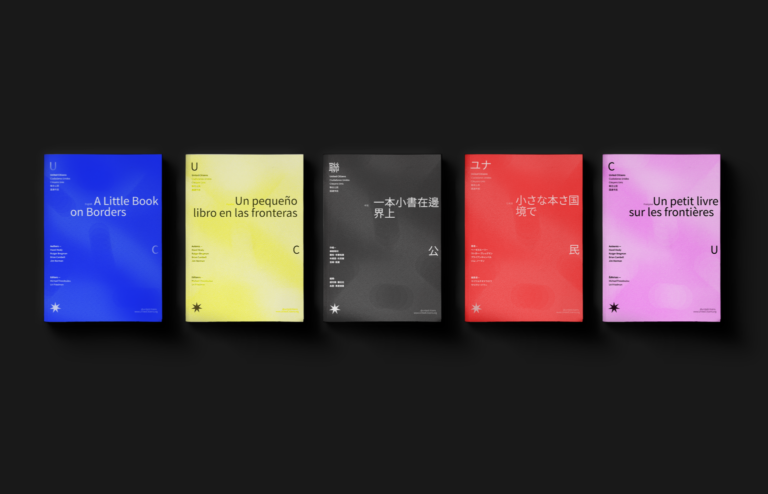
Learn how to be a strategic critical thinker who can solve problems and visually communicate ideas, information, stories and brands across a wide range of media in print, on screens, in the environment and through objects. You will become an interdisciplinary designer fluent in image-making, typography, photography, motion graphics and user experience design.
IADT is running a full-day, on-campus Graphic Design Portfolio Workshop on 18th February. You will be asked to complete a number of practical exercises to demonstrate your skills. Your work will be assessed, and you will receive portfolio points by the 1st March. See below for more details.
Our award-winning programme, has a unique focus on solving complex and diverse real-world problems, by combining the best principles of traditional, new, and emergent graphic design practices to produce highly employable and entrepreneurial graduates with transferable skills that are much sought after by industry.
Portfolio Workshop – 18th February 2026
Once you have applied via CAO for BA [Hons] Graphic Design, IADT will contact you directly to invite you to attend the Portfolio Workshop on 18th February. This is an on-campus workshop from 9.30am–4pm.
You will complete four practical exercises which aim to assess your skills in:
critical thinking, problem solving
sketching, visualising concepts & ideas
image-making & media
making, prototyping & 3D
Your work will be submitted at the end of the day. It will be scored out of a maximum of 600 points. You will receive your Portfolio Workshop points by March 1st, 2026.
IADT will supply a range of materials on the day, but we are happy for you to bring your own drawing materials & media too.
*Note to applicants – in addition to the above Portfolio Workshop application, you can also submit a portfolio by uploading to IADT’s digital portfolio platform by March 10th. Your highest score from either of these methods of application will be counted as your CAO score.
Portfolio Submission
Key Dates
Portfolio Submission Opens
December 2025
CAO Application Deadline
1 February 2026
Portfolio Workshop
18 February 2026
Portfolio Workshop Results
1 March 2026
Portfolio Submission Deadline
10 March 2026
Hear from our lecturers: Graphic Design at IADT
Graphic Design builds on the success of the Visual Communication Design programme, retaining its emphasis on crafting and shaping text and image into coherent and inventive stories, visual artefacts, products, systems, services and experiences. The programme further builds on it’s core principle of interdisciplinarity, by expanding into new fields and blending practices in line with the rapidly changing nature of contemporary design and technology.
Our unique offering, provides small class sizes, a dedicated workspace in state of the art studios, a structured timetable with intensive support from a dedicated teaching team of highly qualified, award-winning lecturers, researchers and professional designers.
We officer industry placements and professional studio practice in Year 3 as well as Erasmus exchanges across Europe, and overseas cultural field trips with your class. This ensures a high quality education and student experience of creative studio practice.
We have a broad range of Erasmus partnerships in Belgium, Finland, France, Germany, Italy, The Netherlands, Poland, and Spain, and is constantly expanding this network. The option to study abroad through the Erasmus Programme is available for one semester in either Years 2 or 3.
What will I do?
Learn to become a confident interdisciplinary designer who can work as a self-directed individual and in multi-disciplinary teams.
Learn critical, practical and technical skills at working across a wide-range of media including printed communication, websites, apps, motion graphics, video, 3D packaging and environmental graphics.
Learn the principles and core disciplines of contemporary graphic design communication
Learn how to communicate information as text (eg. copywriting, critical research and writing, typography), as image (eg. art-direction, illustration, photography, print-making), through motion (moving graphics, animation and video) and interaction (eg. web and app design, social media campaigns)
Formulate and edit stories, messages, and communication systems across multiple platforms and media, including traditional (design for print, spatial environments, broadcast); new (design for screen, motion, user-interface, user-experience, and digital products); and emergent (design for augmented and virtual experiences, systems and services, and wearable technologies)
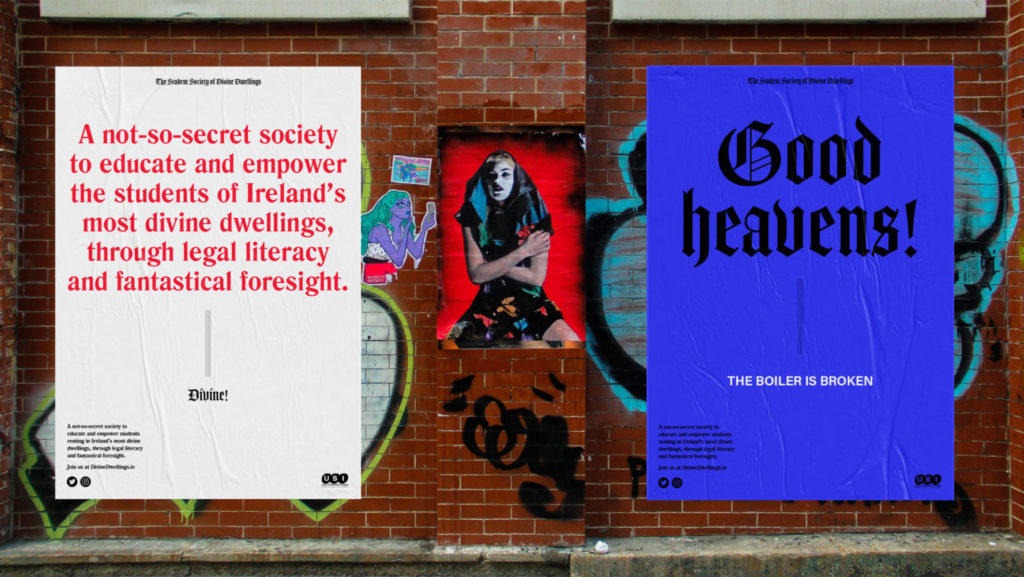
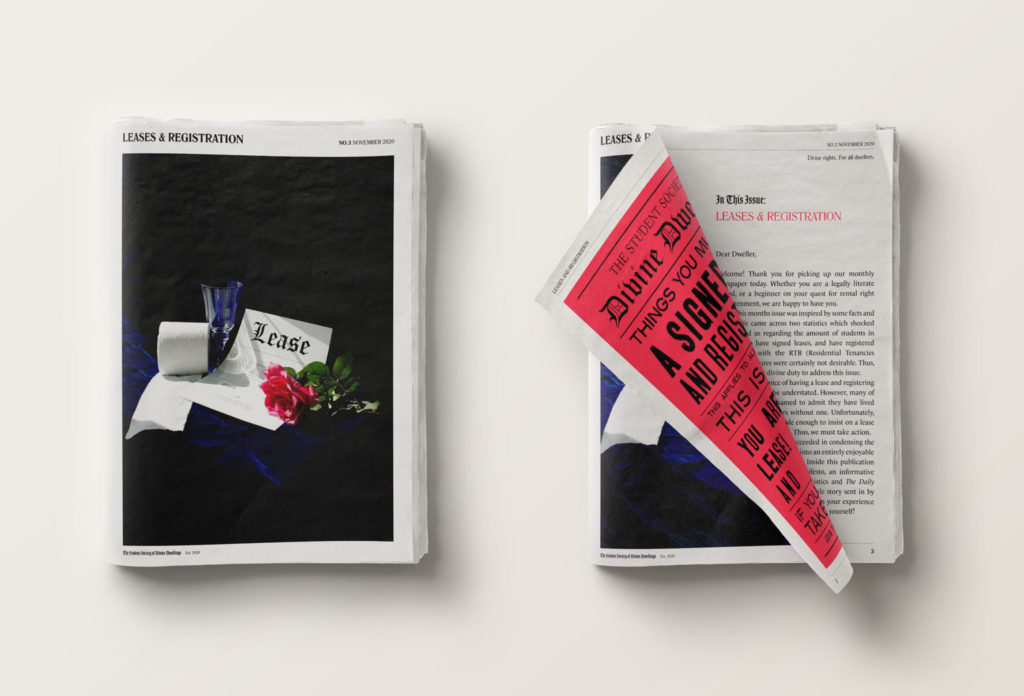
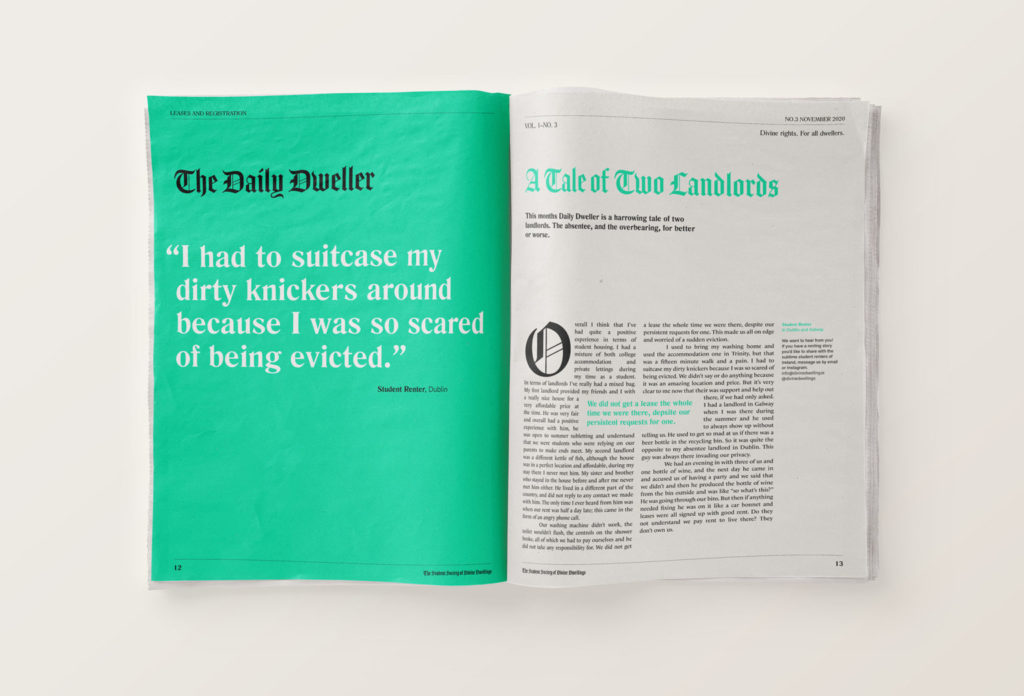
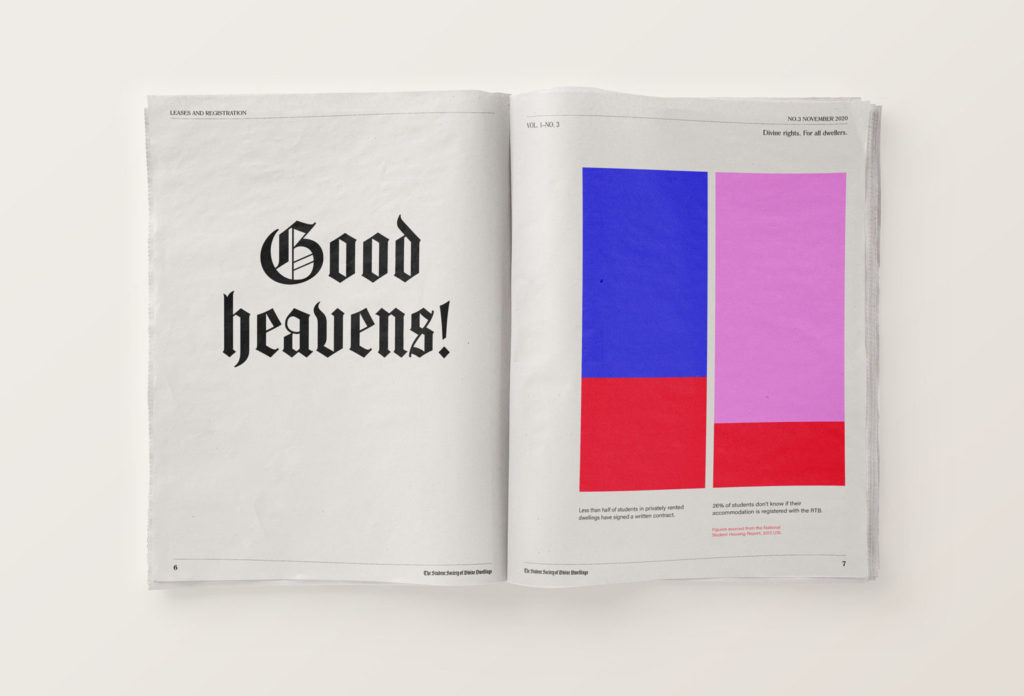
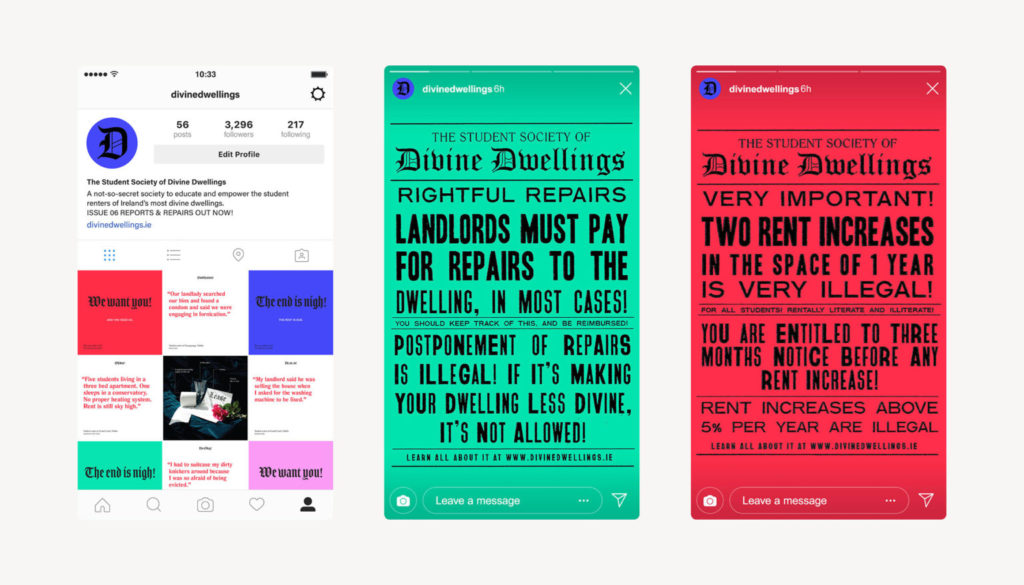
Niamh McArdle — The Student Society of Divine DwellingsNiamh McArdle — The Student Society of Divine DwellingsNiamh McArdle — The Student Society of Divine DwellingsNiamh McArdle — The Student Society of Divine DwellingsNiamh McArdle — The Student Society of Divine DwellingsNiamh McArdle — The Student Society of Divine Dwellings
What will I be able to do when I graduate?
Graduates are highly sought after by industry as proven by high levels of graduate employability and many successes in national and international awards. Areas of employment include: advertising, brand identity, design consultancy, design education, design entrepreneurship, design journalism, design for print and/or screen, design for experiences, design research, design writing and research, digital product design, motion graphics for online digital media, film or television, project management, systems and services design, user-interface and user-experience design (UI/UX).
Completion of the Graphic Design programme opens up many and varied pathways to specialist postgraduate research. Typical examples include further study in: advertising, art/design direction, data-visualisation, design entrepreneurship, design ethics, design futures, design writing and research, illustration, information design, motion design, service design, systems design, typography, UI/UX, and visual and material culture studies.
Approximately €500 per year (in years 1, 2 and 3) for art and design materials. You may also have an opportunity to take part in international field trips in Years 1 and 2 (not compulsory) which cost approx. €500 per trip (which may also be covered by the SUZI grant). Your Year 4 exhibition is your professional showcase; we advise you to budget a minimum of €1000 for this. Please consult with your tutors before purchasing expensive equipment. This will typically comprise a laptop computer (preferably Apple, the design industry standard), a digital camera with an interchangeable lens, a heavy tripod, or a smartphone capable of computational photography. You will need external storage devices for backing up your work. You should anticipate third party software subscriptions of approx. €20 per month.
By clicking "Accept All Cookies" you agree to IADT's use of cookies and similar technologies to enhance your browsing experience, security, analytics, customisation and personalised content. Select "Your Cookie Settings" to make more granular choices. You can read more in our cookies policy.
Necessary
Always active
Some cookies are necessary for the basic functioning of the website and cannot be disabled. These cookies never record any personally identifiable information about you.
Preferences
The technical storage or access is necessary for the legitimate purpose of storing preferences that are not requested by the subscriber or user.
Statistics
The technical storage or access that is used exclusively for statistical purposes.We use statistical cookies to get insights in the usage of our website and to optimise the website experience for our users. We ask your permission to place these analytical cookies before they are set. IADT statistical data is anonymised and does not store any personally identifiable information about you.
Marketing
Website content loaded in embeds, iframes, scripts or web beacons from third party content providers may set cookies and thereby require your prior consent. If you do not allow these Marketing cookies, the below features may not work correctly.
)
)

)